In the vast landscape of temperature sensing, two devices frequently emerge as industry workhorses: the thermocouple and the thermistor. While both are designed to measure temperature, their underlying technologies, operational principles, and ideal applications differ significantly. Choosing the right sensor is paramount for accuracy, reliability, and system efficiency, and often, engineers and enthusiasts alike find themselves weighing the distinct advantages of each. This comprehensive guide will dissect the fundamental mechanics of thermocouples and thermistors, helping you navigate their complexities and make informed decisions for your projects, from industrial processes to precise scientific instruments.
Thermocouple vs. Thermistor: Overview and Benefits
Temperature sensing is a critical element in countless applications, from ensuring food safety in your kitchen to monitoring extreme conditions in manufacturing plants. Getting an accurate and reliable temperature reading often hinges on selecting the appropriate sensor technology. Here, we introduce two of the most prevalent types: thermocouples and thermistors.
What is a Thermocouple?
|
Our Picks for the Best Meat thermometer in 2026
As an Amazon Associate I earn from qualifying purchases.
|
||
| Num | Product | Action |
|---|---|---|
| 1 | Meat Thermometer Digital, Instant Read Meat ThermometerI for Grill and Cooking, Waterproof Food Thermometer for Kitchen and Outside, BBQ, Turkey, Candy, Liquids, Beef |

|
| 2 | Professional Meat Thermometer - Instant Read Food Thermometer with Waterproof Design, Backlight, Hold/Min/Max Function - Cooking Thermometer for Grilling, BBQ, Kitchen Use |
|
| 3 | TempPro TP829 1000ft Wireless Meat Thermometer Digital for Grilling and Smoking, 4 Meat Probes Grill Thermometer for Outside Grill, BBQ Thermometer for Cooking Food Temperature (Previously ThermoPro) |
|
| 4 | Ultrean Digital Meat Thermometer for Cooking,Ultra-Fast Instant Read Food Thermometer with Backlight,Foldable Probe,Waterproof Kitchen Thermometer for BBQ,Grill,Fry,Oven,Candy Making |
|
| 5 | Alpha Grillers Meat Thermometer Digital - Instant Read Food Thermometer for Cooking and Grilling Gifts for Men Valentines Day Gifts for Him Her Mom Dad |
|
| 6 | ThermoPro TP03B Digital Meat Thermometer for Cooking, Instant Read Thermometer with Backlight, Kitchen Food Thermometer for Grill Smoker BBQ Oil Deep Fry Candy Bread Coffee with Pop-up Meat Probe |
|
| 7 | Meat Thermometer Digital with 1 Second Instant Read, Large LED Display, Food Thermometer |
|
| 8 | Meat Thermometer Digital - Instant Read Food Thermometer for Cooking Grilling, Candy, Air Fryer, Griddle Probe Kitchen Gadgets Essentials BBQ Accessories, Valentines Day Gifts for Him Her, Red |
|
| 9 | 0.5 Sec Instant Read Meat Thermometer Digital with ±0.5℉ Precision, Food Thermometer for Cooking Kitchen Gadgets, Oven Grill Candy BBQ Essentials Accessories, Gifts for Him Dad Men Birthday, Red |
|
| 10 | ThermoPro TP19H Digital Meat Thermometer for Cooking with Ambidextrous Backlit and Motion Sensing Kitchen Cooking Food Thermometer for BBQ Grill Smoker Oil Fry Candy Instant Read Thermometer |
|
A thermocouple is an electrical device consisting of two dissimilar electrical conductors forming electrical junctions at differing temperatures. Its operation is rooted in the Seebeck effect, where a temperature difference between two junctions of different metals produces a voltage. This voltage is directly proportional to the temperature difference, making thermocouples a robust choice for a wide array of temperature measurements. They are self-powered, requiring no external excitation, and are known for their ability to withstand extreme environments and broad temperature ranges.
What is a Thermistor?
The term “thermistor” is a portmanteau of “thermal resistor,” accurately describing its function: a resistor whose resistance is highly sensitive to temperature changes. Typically crafted from semiconductor materials like metallic oxides, thermistors exhibit a predictable change in electrical resistance when subjected to varying temperatures. They are highly sensitive, capable of detecting minute temperature shifts with great precision, especially within their specified operating ranges. This sensitivity makes them excellent for applications where precise temperature control at moderate temperatures is crucial.
Why Temperature Sensors Matter
The ability to accurately measure temperature is fundamental across numerous sectors. In manufacturing, it ensures process quality and safety; in HVAC systems, it optimizes energy consumption and comfort; and in medical devices, it monitors patient vitals. Understanding the nuances between sensor types allows for the precise control and monitoring essential for optimal performance, preventing potential hazards, and maximizing efficiency in any system requiring thermal intelligence.
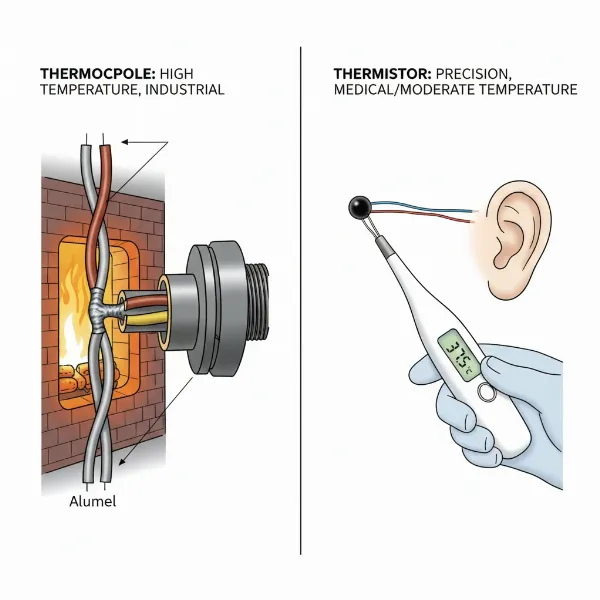 Illustration comparing a thermocouple and a thermistor with their respective applications
Choosing the Right Temperature Sensor: Thermocouple vs. Thermistor
Selecting the ideal temperature sensor isn’t a one-size-fits-all endeavor; it requires a careful evaluation of your specific application’s demands. While both thermocouples and thermistors serve to measure temperature, their distinct characteristics make each better suited for different scenarios. Considering factors like the temperature range, required accuracy, response speed, environmental durability, and overall cost will guide you toward the most effective solution.
When faced with a choice, consider these critical factors:
- Temperature Range: Thermocouples are renowned for their ability to measure across an exceptionally broad spectrum, from cryogenic lows to scorching highs, often exceeding 1750°C. Thermistors, while highly accurate, typically operate within a more confined range, usually between -50°C and 250°C, making them suitable for moderate temperature applications.
- Accuracy: For precise measurements within their operational sweet spot, thermistors often exhibit superior accuracy and resolution, capable of detecting small incremental temperature changes due to their significant resistance change per degree Celsius. Thermocouples offer good accuracy over their wide range, but may have lower absolute accuracy compared to thermistors in certain narrow bands.
- Response Time: The speed at which a sensor reacts to a temperature change is vital in dynamic environments. Thermistors can offer rapid response times, often under a second for smaller probes, while thermocouples typically respond within 0.12 to 10 seconds, depending on their size and packaging.
- Durability and Robustness: Thermocouples are generally more rugged and durable, tolerating harsh industrial conditions, high vibrations, and corrosive environments with greater resilience. Thermistors, especially those with epoxy coatings, can be more fragile and susceptible to physical or chemical stress.
- Cost: On a per-unit basis, thermistors are often less expensive than thermocouples. However, the overall system cost can vary, as thermocouples may require more complex signal conditioning (like cold junction compensation) which adds to the expense.
- Linearity: The relationship between temperature and output signal is crucial for accurate data interpretation. Thermocouples have a non-linear but well-defined output curve, while thermistors are highly non-linear, often requiring linearization circuitry or complex algorithms for accurate readings over their full range.
“The choice between a thermocouple and a thermistor often boils down to a fundamental trade-off: do you need to measure across an extreme temperature range, or do you prioritize pinpoint accuracy within a more limited, moderate range?” – Dr. Alistair Finch, Senior Materials Engineer.
Comparison Table: Key Characteristics of Thermocouples and Thermistors
To provide a quick reference, the table below highlights the primary distinctions and shared characteristics between thermocouple and thermistor technologies, aiding in a swift evaluation for various engineering needs.
| Feature | Thermocouple | Thermistor |
|---|---|---|
| Working Principle | Seebeck effect (voltage from dissimilar metals) | Resistance change with temperature (semiconductor) |
| Sensing Parameter | Voltage (millivolts) | Resistance (ohms) |
| Temperature Range | Very wide (-200°C to 1750°C, depending on type) | Limited (-50°C to 250°C, typical for NTC) |
| Accuracy | Good across wide range, moderate absolute accuracy | High within narrow range, high sensitivity |
| Response Time | Fast to moderate (0.12 – 10 seconds) | Very fast (often < 1 second for smaller sizes) |
| Linearity | Non-linear, but predictable | Highly non-linear |
| Durability | Very robust, suitable for harsh environments | More fragile, sensitive to stress and contamination |
| Cost | Generally moderate to high (system cost) | Generally low (sensor cost) |
| Self-Heating | Minimal to none (passive device) | Can occur (active device, current flow heats sensor) |
| External Power | Not required (self-generating) | Required (for resistance measurement) |
| Reference Junction | Required for accurate measurement | Not required |
Detailed Exploration of Thermocouple and Thermistor Technologies
Delving deeper into each technology reveals the intricate engineering behind their temperature-sensing capabilities. Understanding their specific operational mechanisms, typical variations, and inherent strengths and weaknesses is key to mastering their application.
Thermocouple Technology Deep Dive
Thermocouples operate on the principle discovered by Thomas Seebeck in 1821: when two wires made of dissimilar metals are joined at two points, and these junctions are held at different temperatures, a small voltage is generated. This is known as the Seebeck effect.
- Working Principle: A thermocouple essentially consists of two junctions: a “hot junction” (measuring junction) exposed to the temperature to be measured, and a “cold junction” (reference junction) kept at a known, stable temperature. The temperature difference between these two junctions produces an electromotive force (EMF) or voltage, which is then measured and translated into a temperature reading. Modern systems often use electronic cold junction compensation (CJC) to simulate a reference junction, simplifying usage.
- Types: Thermocouples are categorized into various types, designated by letters, each composed of specific metal alloys and suited for particular temperature ranges and environments. Common types include:
- Type K (Chromel-Alumel): Most common, wide range (-200°C to 1250°C), good general purpose.
- Type J (Iron-Constantan): Narrower range than K, useful in reducing atmospheres (-40°C to 750°C).
- Type T (Copper-Constantan): Excellent for cryogenic and low-temperature applications (-200°C to 370°C).
- Type E (Chromel-Constantan): Produces the highest EMF output, offering good accuracy at moderate temperatures (-200°C to 900°C).
- Noble Metal Types (R, S, B): Utilize platinum and rhodium alloys, ideal for extremely high temperatures (up to 1700°C for R/S, 1800°C for B).
- Advantages:
- Wide Temperature Range: Unmatched for measuring extremely high or low temperatures.
- Robustness: Can withstand harsh industrial environments, including high vibration and pressure.
- Self-Powered: Generates its own voltage, eliminating the need for external power at the sensor itself.
- Fast Response: Generally quick to respond to temperature changes, particularly with exposed junctions.
- Disadvantages:
- Lower Absolute Accuracy: While consistent, they can be less precise than thermistors or RTDs in specific moderate ranges.
- Requires Reference Junction Compensation: The cold junction must be at a known temperature or compensated for, adding complexity to the measurement system.
- Non-linear Output: The voltage-temperature relationship is not perfectly linear, necessitating linearization in measurement circuitry.
- Drift Over Time: Due to material changes like oxidation, accuracy can degrade over extended periods, especially at high temperatures.
Thermistor Technology Deep Dive
Thermistors, or thermal resistors, are solid-state devices crafted from semiconductor materials whose electrical resistance changes significantly with temperature. This property makes them incredibly sensitive temperature detectors.
- Working Principle: Unlike thermocouples that generate voltage, thermistors work by changing their electrical resistance in response to temperature. This change is measured by passing a small current through the thermistor and observing the voltage drop. The relationship between resistance and temperature is non-linear but highly repeatable for a given thermistor.
- Types: Thermistors are primarily categorized by how their resistance changes with temperature:
- Negative Temperature Coefficient (NTC) Thermistors: These are the most common type. As temperature increases, their resistance decreases. This inverse relationship provides high sensitivity and is widely used for temperature measurement and control.
- Positive Temperature Coefficient (PTC) Thermistors: In contrast, as temperature increases, the resistance of PTC thermistors increases. They typically exhibit a sharp, non-linear resistance increase at a specific “switching temperature” and are often used in current limiting or over-temperature protection applications rather than precise measurement.
- Advantages:
- High Sensitivity: Can detect extremely small changes in temperature due to a large resistance change per degree Celsius.
- Excellent Accuracy: Offers very high precision within its limited operating range.
- Fast Response Time: Small thermistors can provide very rapid temperature readings.
- Low Cost: Generally more affordable than other precision temperature sensors.
- Compact Size: Can be manufactured in very small packages, ideal for tight spaces.
- Disadvantages:
- Limited Temperature Range: Cannot withstand the extreme temperatures that thermocouples can, typically operating up to 250°C.
- Highly Non-linear Output: Requires more complex linearization circuitry or software to accurately convert resistance to temperature across its full range.
- Self-Heating: Because a current must pass through the thermistor to measure its resistance, it can generate its own heat, potentially leading to measurement errors if not properly managed.
- Fragility: Semiconductor materials can be more fragile than the robust metal wires of thermocouples, making them susceptible to mechanical stress.
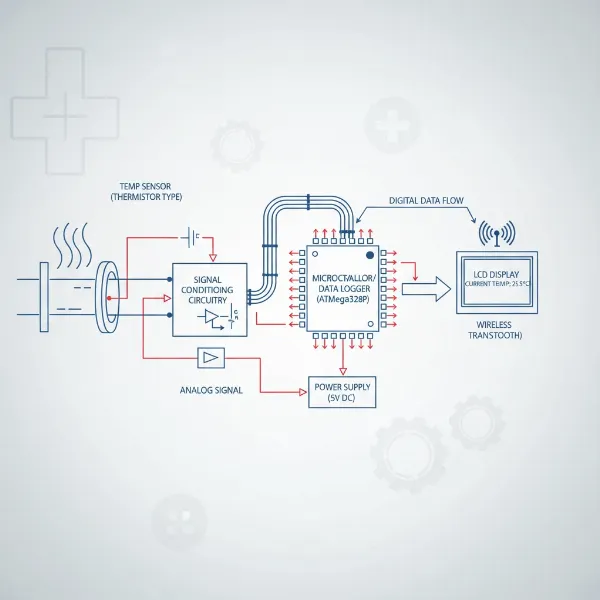 Diagram showing a temperature sensor integrated into a control or measurement system
Using and Maintaining Thermocouple and Thermistor Sensors
Proper usage and maintenance are critical to ensuring the longevity, accuracy, and reliability of both thermocouple and thermistor sensors. Even the most advanced technology can falter without the right care and installation practices.
Installation Best Practices
- Proper Placement: Ensure the sensor is located precisely where the temperature needs to be measured, providing good thermal contact with the object or environment. Avoid placing it near heat sources or sinks that might not represent the true temperature of your target.
- Avoid Electrical Noise: Both sensor types, particularly thermocouples, can be susceptible to electrical interference. Use shielded cables and ensure proper grounding to minimize noise, especially in industrial settings with motors or high-power electronics.
- Thermal Contact: For direct contact measurements, ensure a secure and consistent thermal connection. Thermal paste can improve contact for surface measurements, while immersion probes should be fully submerged where appropriate.
- Probe Protection: Use appropriate thermowells or sheaths for thermocouples and protective encapsulation for thermistors, especially in corrosive, abrasive, or high-pressure environments, to shield the sensor element from damage.
Calibration
Regular calibration is vital for maintaining the accuracy of your temperature sensors over time.
- Thermocouples: Due to potential drift and the need for accurate cold junction compensation, thermocouples benefit from periodic calibration against known reference standards. The thermoelectric properties of the metals can change with age and exposure to extreme temperatures.
- Thermistors: While generally more stable, thermistors can also drift. Their highly non-linear nature means calibration points across their operating range are often necessary to maintain precision, especially if using a simplified linearization.
Common Issues & Troubleshooting
- Sensor Drift: A common issue where the sensor’s reading gradually deviates from the true temperature. This can be caused by aging, material contamination (for thermocouples), or mechanical stress. Recalibration or replacement is often necessary.
- Electrical Interference: Inaccurate or noisy readings can stem from electromagnetic interference (EMI). Check wiring, shielding, and grounding.
- Physical Damage: Kinks in thermocouple wires, cracked thermistor encapsulation, or corroded probe tips can lead to erratic readings or complete failure. Visually inspect sensors regularly.
- Self-Heating (Thermistors): If the current passing through a thermistor is too high, it can heat itself, leading to falsely elevated temperature readings. Ensure the measurement current is minimal.
Maintenance Tips
- Cleaning: Keep sensor probes clean, especially if they come into contact with process fluids or food. Residue can create insulation, slowing response time or affecting accuracy.
- Avoid Contamination: Protect sensors from chemical exposure that can degrade their materials, particularly for thermocouples in harsh atmospheres.
- Proper Storage: Store spare sensors in a clean, dry environment within their specified conditions to prevent premature aging or damage.
Applications and Advanced Tips for Temperature Measurement
The diverse characteristics of thermocouples and thermistors make them indispensable in a vast array of applications. Understanding where each technology excels, and how they can even complement each other, unlocks optimal performance in temperature measurement and control.
Typical Applications
The selection of a thermocouple or thermistor is almost always dictated by the specific demands of the environment and the required precision.
- Thermocouple Applications: Due to their wide temperature range and robustness, thermocouples are ubiquitous in heavy industrial settings. They are the sensor of choice for:
- Industrial ovens, furnaces, and kilns, where temperatures can reach extreme highs.
- Exhaust gas temperature monitoring in engines and turbines.
- High-temperature chemical processes and refining.
- Power generation plants, including nuclear and fossil fuel facilities.
- Many commercial and industrial food processing applications requiring high-temperature cooking.
- Thermistor Applications: Their high sensitivity and accuracy within more moderate ranges make thermistors ideal for:
- Medical devices, such as patient temperature monitoring and incubators, where precision is critical.
- HVAC systems for precise climate control and energy efficiency.
- Home appliances like digital meat thermometers, ovens, and refrigerators, where they provide accurate readings for optimal performance.
- Automotive applications, including monitoring engine coolant, oil temperature, and cabin climate control.
- Battery management systems, precisely tracking cell temperatures to optimize performance and safety.
Beyond Basic Measurement
Both thermocouples and thermistors can be integrated into more advanced systems to achieve sophisticated temperature management.
- Temperature Compensation: Thermistors are often used to compensate for temperature drift in other electronic components, maintaining stable circuit performance across varying ambient conditions.
- Over-Temperature Protection: PTC thermistors are excellent for safeguarding electronics from overheating. When a critical temperature is reached, their resistance sharply increases, effectively cutting off current flow and protecting sensitive components.
- Differential Measurements: Using multiple sensors allows for differential temperature measurements, crucial in heat exchangers, chillers, or specific scientific experiments to understand temperature gradients.
- Data Logging and Control Systems: Both sensor types are routinely interfaced with microcontrollers and PLCs (Programmable Logic Controllers) to enable automated temperature logging, sophisticated PID (Proportional-Integral-Derivative) control loops, and remote monitoring. This integration ensures not just measurement, but active management of thermal environments.
Conclusion
Choosing between a thermocouple and a thermistor ultimately hinges on understanding the unique demands of your application. Thermocouples offer unparalleled durability and the ability to measure across extreme temperature ranges, making them the default for harsh industrial environments and high-temperature processes. Their self-powered operation adds to their robustness in challenging settings. In contrast, thermistors provide exceptional sensitivity and precision within more moderate temperature bands, making them ideal for applications like medical devices or household appliances where minute temperature changes require accurate detection. While thermistors are generally more cost-effective and offer faster response, their non-linearity and limited range must be considered. By carefully weighing these technological distinctions against your specific needs, you can confidently select the sensor that will deliver the most reliable and accurate temperature data for your project, ensuring optimal performance and safety. What specific temperature challenges are you looking to solve in your next design?
Frequently Asked Questions
Which sensor is more accurate: thermocouple or thermistor?
Thermistors are generally more accurate and sensitive over their limited operating temperature range, often providing precision within ±0.1°C. Thermocouples, while robust and suitable for wide ranges, typically offer moderate absolute accuracy, which can be around ±1°C or more, depending on type and specific application.
Can a thermistor replace a thermocouple?
In most cases, a thermistor cannot directly replace a thermocouple. Thermistors have a much more limited temperature range, typically up to 250°C, whereas thermocouples can measure up to 1750°C or more. A replacement is only feasible if the application’s entire temperature range falls within the thermistor’s operational limits and its non-linear output can be adequately handled.
What is the main difference in how they work?
The core difference lies in their sensing principle: a thermocouple measures temperature by generating a voltage across two dissimilar metal junctions (Seebeck effect), while a thermistor measures temperature by changing its electrical resistance, which is then measured by an external circuit.
Do thermocouples or thermistors require external power?
Thermocouples do not require external power to generate a signal; they are passive, self-generating devices. Thermistors, however, are resistive devices and require an external current to flow through them to measure their resistance change, which then indicates the temperature.
Which is better for very high temperatures?
For very high temperatures (above 250°C to thousands of degrees Celsius), thermocouples are unequivocally the superior choice. Their metallic construction and operating principle allow them to withstand and accurately measure temperatures that would destroy a thermistor.
Are thermistors more fragile than thermocouples?
Yes, thermistors are generally more fragile than thermocouples. They are typically made from semiconductor materials encapsulated in glass or epoxy, making them susceptible to mechanical shock, vibration, and certain chemical exposures, unlike the more robust metal-wire construction of most thermocouples.
What are common applications for each?
Thermistors are often found in precise, moderate-temperature applications like medical devices, HVAC systems, and household appliances. Thermocouples are prevalent in harsh, high-temperature industrial settings such as furnaces, kilns, power plants, and chemical processing facilities due to their durability and wide range.