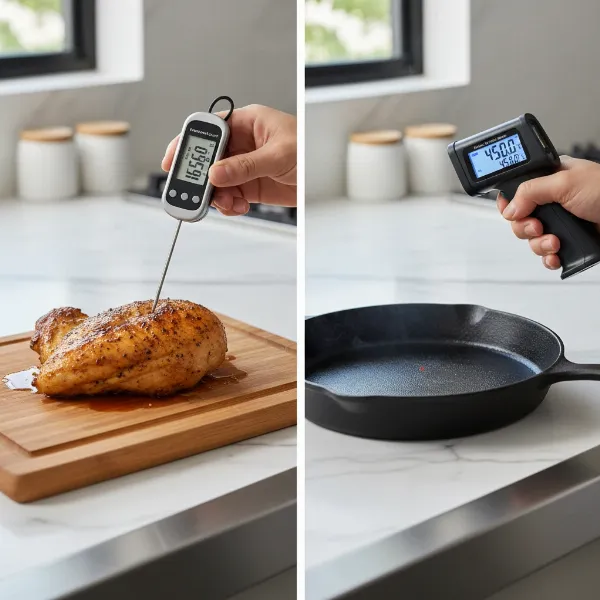
For any home cook or professional chef striving for culinary perfection, temperature control is paramount. Whether you’re roasting a succulent holiday turkey or crafting delicate caramel confections, the right thermometer isn’t just a convenience—it’s a necessity. While both meat thermometers and candy thermometers are designed to measure heat, they are specialized tools, each engineered for distinct purposes and environments. Understanding their fundamental differences is key to achieving consistent, safe, and delicious results in your kitchen. This guide will delve into what sets these essential kitchen gadgets apart, helping you choose the perfect tool for your next culinary adventure.
Meat Thermometer vs. Candy Thermometer: An Overview and Their Benefits
At first glance, one might assume all food thermometers are interchangeable, but nothing could be further from the truth. Each type is meticulously designed to excel in specific cooking scenarios, ensuring both food safety and optimal texture.
What is a Meat Thermometer?
|
Our Picks for the Best Meat thermometer in 2026
As an Amazon Associate I earn from qualifying purchases.
|
||
| Num | Product | Action |
|---|---|---|
| 1 | ThermoPro TP03B Digital Meat Thermometer for Cooking, Instant Read Thermometer with Backlight, Kitchen Food Thermometer for Grill Smoker BBQ Oil Deep Fry Candy Bread Coffee with Pop-up Meat Probe |

|
| 2 | Meat Thermometer Digital, Instant Read Meat ThermometerI for Grill and Cooking, Waterproof Food Thermometer for Kitchen and Outside, BBQ, Turkey, Candy, Liquids, Beef |
|
| 3 | TempPro TP829 1000ft Wireless Meat Thermometer Digital for Grilling and Smoking, 4 Meat Probes Grill Thermometer for Outside Grill, BBQ Thermometer for Cooking Food Temperature (Previously ThermoPro) |
|
| 4 | Professional Meat Thermometer - Instant Read Food Thermometer with Waterproof Design, Backlight, Hold/Min/Max Function - Cooking Thermometer for Grilling, BBQ, Kitchen Use |
|
| 5 | Alpha Grillers Meat Thermometer Digital - Instant Read Food Thermometer for Cooking and Grilling Gifts for Men Valentines Day Gifts for Him Her Mom Dad |
|
| 6 | Meat Thermometer Digital - Instant Read Food Thermometer for Cooking Grilling, Candy, Air Fryer, Griddle Probe Kitchen Gadgets Essentials BBQ Accessories, Valentines Day Gifts for Him Her, Red |
|
| 7 | Ultrean Digital Meat Thermometer for Cooking,Ultra-Fast Instant Read Food Thermometer with Backlight,Foldable Probe,Waterproof Kitchen Thermometer for BBQ,Grill,Fry,Oven,Candy Making |
|
| 8 | Meat Thermometer Digital with 1 Second Instant Read, Large LED Display, Food Thermometer |
|
| 9 | ThermoPro TP19H Digital Meat Thermometer for Cooking with Ambidextrous Backlit and Motion Sensing Kitchen Cooking Food Thermometer for BBQ Grill Smoker Oil Fry Candy Instant Read Thermometer |
|
| 10 | 0.5 Sec Instant Read Meat Thermometer Digital with ±0.5℉ Precision, Food Thermometer for Cooking Kitchen Gadgets, Oven Grill Candy BBQ Essentials Accessories, Gifts for Him Dad Men Birthday, Red |
|
A meat thermometer is a crucial instrument designed to measure the internal temperature of solid foods, primarily meats. Its core purpose is to confirm that meats reach a safe internal temperature to eliminate harmful bacteria and to ensure they are cooked to your desired level of doneness, from rare steak to well-done poultry. Common types include instant-read digital thermometers, which provide quick readings, and leave-in probe thermometers, often with smart features or remote monitoring, ideal for roasts or grilling.
Why Use a Meat Thermometer?
The primary benefit of a meat thermometer lies in food safety and precision. Undercooked meats can pose serious health risks, while overcooked meats become dry and unappetizing. A reliable meat thermometer eliminates guesswork, guaranteeing your dishes are both safe to eat and perfectly tender and juicy, every single time. It’s an indispensable tool for roasting, grilling, smoking, and even sous vide cooking.
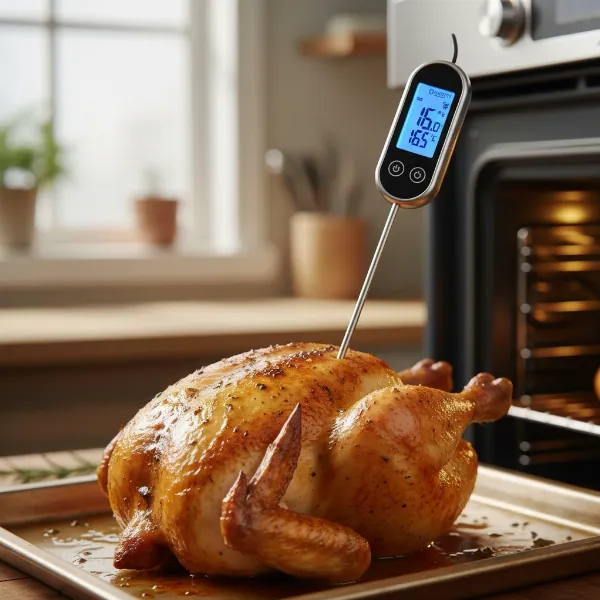 Digital meat thermometer accurately measures internal temperature of a roasted chicken, ensuring perfect doneness.
What is a Candy Thermometer?
A candy thermometer, also known as a deep-fry thermometer, is engineered to measure the high temperatures of liquids, specifically boiling sugar syrups, oils, and other hot liquid preparations. These thermometers often feature a clip to attach to the side of a pot, allowing them to remain immersed without needing to be held.
Why Use a Candy Thermometer?
The world of confectionery and deep-frying demands extreme precision. Small temperature fluctuations can drastically alter the texture and outcome of candies, turning a perfect caramel into a sticky mess or a brittle into a burnt disaster. A candy thermometer provides the accuracy needed to hit precise sugar stages (like soft-ball, firm-ball, or hard-crack) or maintain optimal oil temperatures for frying, ensuring consistently perfect results for your sweet treats and crispy fried foods.
Overall Benefits of Using the Right Thermometer
Ultimately, employing the correct thermometer for the task at hand elevates your cooking from good to gourmet. It provides confidence, prevents costly mistakes, and ensures that every dish, savory or sweet, meets the highest standards of quality, safety, and taste.
Navigating Your Choice: Key Factors When Selecting a Thermometer
Choosing between a meat thermometer and a candy thermometer hinges on several critical factors, primarily their specialized design and functional capabilities. Understanding these distinctions is vital for making the right choice.
Temperature Range: The Most Critical Difference
The most significant divergence between these two tools is their calibrated temperature range, tailored to the specific temperatures required for their respective applications.
- Meat Thermometers: Typically designed to measure temperatures up to approximately 200°F to 300°F (93°C to 149°C). This range is more than adequate for cooking all types of meat, as poultry usually needs to reach 165°F (74°C) for safety, and even well-done beef rarely exceeds 170°F (77°C).
- Candy Thermometers: These instruments are built to withstand and accurately measure much higher temperatures, often reaching up to 400°F or even 500°F (204°C to 260°C). Such high temperatures are essential for sugar work, where caramelization can occur above 320°F (160°C) and hard crack stage sugar requires temperatures around 300-310°F (149-154°C).
Design and Probe Type
The physical design of each thermometer reflects its intended use, prioritizing safety and effectiveness for different food types.
- Meat Thermometers: These generally feature a sharp, pointed probe designed to be easily inserted into the dense, solid flesh of meat. Probes can vary in length, with longer versions suited for large roasts. Their form factor might be an instant-read wand or a probe connected by a wire to a base unit.
- Candy Thermometers: Typically longer and narrower, often with a rounded or flat end to prevent scratching pots or becoming lodged in sticky sugar. They commonly include an adjustable clip to secure them to the side of a pot, ensuring the bulb or sensor is immersed in the liquid without touching the bottom. This design also helps maintain a safe distance from extremely hot liquids.
Display Features
The information presented on each thermometer’s display is optimized for its specific culinary domain.
- Meat Thermometers: Displays often show a single, clear temperature reading, sometimes accompanied by markings for safe internal temperatures of common meats (e.g., poultry, beef, pork). Digital models may offer additional features like preset temperature alarms.
- Candy Thermometers: Beyond numerical temperature, many candy thermometers feature specific markings for various sugar stages, such as “soft-ball,” “firm-ball,” “hard-ball,” “soft-crack,” “hard-crack,” and “caramel.” These visual guides are indispensable for precise confectionery work.
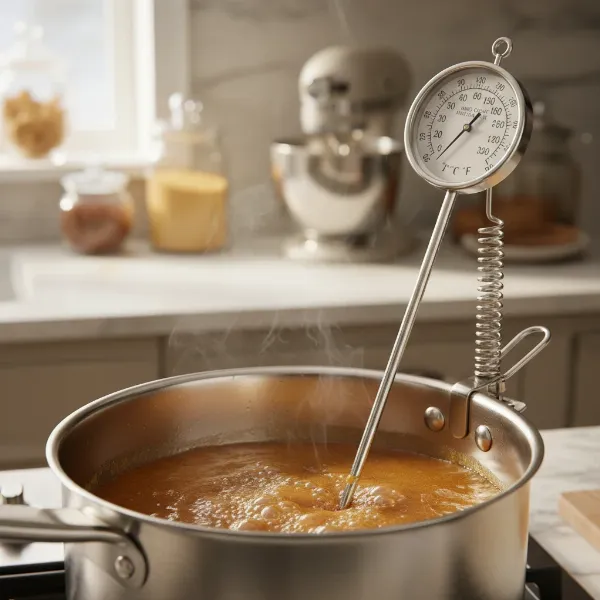 Candy thermometer accurately monitors high temperature of bubbling caramel sauce in a pot.
Intended Use: Meat (Solid Food) vs. Candy (Liquids)
This distinction is fundamental. Meat thermometers are for internal temperatures of solid proteins, while candy thermometers are for the immersion in and monitoring of hot liquid mixtures.
Interchangeability: Why They Are NOT Interchangeable
Due to their vastly different temperature ranges, probe designs, and safety features, meat and candy thermometers are not interchangeable. Using a meat thermometer for candy making could be dangerous, as it might not measure high enough temperatures and its shorter probe could put your hands at risk. Conversely, a candy thermometer’s higher temperature range and less pointed probe make it unsuitable for accurately measuring the internal temperature of a solid cut of meat.
Comparison Table: Top Considerations for Each Thermometer Type
| Feature | Meat Thermometer | Candy Thermometer |
|---|---|---|
| Max Temp | 200°F – 300°F (93°C – 149°C) | 400°F – 500°F (204°C – 260°C) |
| Probe Type | Sharp, pointed, for solid insertion | Rounded/flat base, longer, for liquid immersion |
| Best Use | Roasting, grilling, smoking meats; food safety | Candy making, deep frying, syrups, tempering chocolate |
| Key Feature | Fast, accurate internal readings; doneness levels | High-temperature stability; sugar stage markings |
| Safety | Ensures safe internal temperature of meats | Protects from hot liquids; prevents burns |
| Attachment | Handheld, or probe with remote unit | Often includes an adjustable pot clip |
Detailed Insights: Understanding Specific Thermometer Types
Both meat and candy thermometers come in various forms, each offering distinct advantages.
Meat Thermometer Deep Dive
- Instant-Read Digital Meat Thermometers: These are a favorite for their speed and accuracy. With a thin probe and a digital display, they provide a temperature reading within seconds, making them ideal for quick checks on steaks, chicken breasts, or burgers. They are handheld and not typically left in the food during cooking.
- Leave-In Probe Meat Thermometers: Designed to remain in the meat throughout the cooking process, these often consist of a probe connected by a heat-resistant wire to an external display unit. Many modern versions feature wireless connectivity or smart capabilities, allowing you to monitor temperatures remotely via an app. They are perfect for large roasts, briskets, or turkeys cooked in ovens, grills, or smokers.
- Dial Meat Thermometers (Analog): These traditional thermometers use a bimetallic coil or a liquid-filled tube to display temperature on a dial. While generally less expensive, they can be slower to register temperatures and may require calibration more frequently. Some are designed as instant-read, others as leave-in.
Regardless of type, accuracy and speed are paramount for meat thermometers. A fast, precise reading ensures you pull your meat off the heat at the exact right moment.
Candy Thermometer Deep Dive
- Glass/Analog Candy Thermometers: These traditional thermometers often contain mercury or alcohol and feature a clearly marked scale with sugar stages. They are typically long and slender, designed for deep immersion in liquids. They can be fragile but are often very reliable.
- Digital Candy Thermometers: Offering greater precision and often faster readings, digital candy thermometers provide a numerical display. Some may still feature pre-programmed sugar stages or audible alarms when target temperatures are reached. They are generally more robust than their glass counterparts.
For candy making, the ability to calibrate your thermometer is crucial. Even a slight inaccuracy can ruin an entire batch of candy, so regular calibration against a known temperature (like boiling water) ensures reliable results.
Using and Caring for Your Precision Tools
Even the best thermometer is only as effective as its user. Proper technique and diligent maintenance are key to longevity and accuracy.
Proper Use
- How to Correctly Use a Meat Thermometer: For accurate readings, always insert the probe into the thickest part of the meat, avoiding bones, fat, or gristle, as these can give false readings. For poultry, ensure the probe is deep into the thigh or breast. For roasts, aim for the center. If using a leave-in probe, ensure the wire is protected from direct flame or heating elements.
- How to Correctly Use a Candy Thermometer: Attach the thermometer to the side of your pot so that the bulb or sensor is immersed in the liquid but not touching the bottom. If it touches the bottom, it will read the temperature of the pot, not the liquid. Monitor the temperature closely, especially when approaching critical sugar stages, as temperatures can rise rapidly.
Cleaning and Maintenance
- Hygiene for Probes: Always clean your thermometer probe thoroughly after each use. For meat thermometers, this is critical for preventing cross-contamination. Most probes can be wiped clean with a damp, soapy cloth or alcohol wipe. Never immerse the entire unit (especially digital ones) in water unless specified by the manufacturer.
- Storage Tips: Store thermometers in a protective sleeve or case to prevent damage to the probe or screen. Keep them away from extreme temperatures or humidity to maintain their accuracy.
- Calibration and Battery Replacement: Regularly check the calibration of your thermometers. For analog models, this might involve adjusting a nut. Digital models often have calibration features or may simply require battery replacement when readings become erratic. A simple ice bath or boiling water test can confirm accuracy.
Common Mistakes
- Using the Wrong Thermometer: The most common error, leading to inaccurate results and potential safety hazards.
- Incorrect Probe Placement: For meat, inserting the probe into bone or fat; for candy, letting the probe touch the bottom of the pot.
- Not Calibrating: Over time, thermometers can lose accuracy. Regular calibration ensures they are always providing true readings.
Elevate Your Culinary Skills with the Right Thermometer
With the right precision tool in hand, you unlock a world of culinary possibilities, ensuring consistently perfect results that impress.
Achieving Perfect Meat Doneness
A meat thermometer is your secret weapon for perfectly cooked meat. Here are some ideal internal temperatures for common meats:
- Beef & Lamb:
- Rare: 125-130°F (52-54°C)
- Medium-Rare: 130-135°F (54-57°C)
- Medium: 135-140°F (57-60°C)
- Well-Done: 155°F (68°C)
- Pork: 145°F (63°C)
- Poultry (Chicken, Turkey): 165°F (74°C)
- Ground Meats: 160°F (71°C)
Always remember to allow for carryover cooking, where the internal temperature continues to rise slightly after the meat is removed from the heat.
Mastering Candy Stages
A candy thermometer is indispensable for navigating the delicate science of confectionery, ensuring your sugar reaches the precise stage required.
- Thread Stage (230-235°F / 110-113°C): Sugar forms a thin thread when dropped from a spoon. Used for syrups.
- Soft-Ball Stage (235-240°F / 113-116°C): Sugar forms a soft, pliable ball when dropped into cold water. Used for fudge, fondant.
- Firm-Ball Stage (245-250°F / 118-121°C): Sugar forms a firm but still pliable ball. Used for caramels.
- Hard-Ball Stage (250-265°F / 121-129°C): Sugar forms a hard but still malleable ball. Used for nougat, rock candy.
- Soft-Crack Stage (270-290°F / 132-143°C): Sugar forms threads that are flexible but break easily. Used for butterscotch.
- Hard-Crack Stage (300-310°F / 149-154°C): Sugar threads are brittle and break cleanly. Used for lollipops, brittle.
- Caramel Stage (320-350°F / 160-177°C): Sugar turns golden brown and develops a nutty flavor.
Beyond Meat and Candy: Other Uses
Many candy thermometers can double as deep-fry thermometers, essential for maintaining stable oil temperatures for perfectly crispy fried foods. Meat thermometers are also useful for checking the temperature of casseroles or reheating leftovers to ensure they are piping hot and safe.
Conclusion
The distinction between a candy thermometer and a meat thermometer is far more than a mere nuance; it’s a fundamental difference in design, temperature range, and intended application. While both are invaluable tools for precision cooking, they are not interchangeable. A meat thermometer ensures your savory dishes are cooked to perfection and safe to eat, while a candy thermometer is your indispensable guide for mastering the delicate art of confectionery. Investing in both, and understanding their unique roles, will undoubtedly elevate your culinary prowess, transforming your kitchen into a realm of consistent excellence. Which culinary creations are you excited to perfect with the right thermometer by your side?
Frequently Asked Questions
Can I use a meat thermometer for candy making?
No, it is strongly advised against using a meat thermometer for candy making. Meat thermometers have a lower maximum temperature range, typically topping out around 200-300°F, which is insufficient for the much higher temperatures required for sugar work (up to 500°F). Using one could lead to inaccurate readings and potential damage to the thermometer.
Can I use a candy thermometer for meat?
While a candy thermometer can measure lower temperatures, its design is not ideal for meat. The long, often rounded probe is not meant for insertion into solid meat, and its high temperature range might make the lower meat cooking temperatures less precise on the scale. For accurate internal meat temperatures, a specialized meat thermometer is best.
What is the maximum temperature for a meat thermometer?
Most meat thermometers are designed to accurately read temperatures up to approximately 200°F to 300°F (93°C to 149°C). This range is perfectly suitable for ensuring all types of meats reach their safe internal cooking temperatures without being overcooked.
What temperature does sugar need to reach for caramel?
To achieve a rich, golden caramel, sugar typically needs to reach temperatures between 320°F and 350°F (160°C and 177°C). This process involves the sugar breaking down and reorganizing, giving it its characteristic color and deep, complex flavor.
How do I calibrate my thermometer?
A common method for calibrating a thermometer is the ice bath test. Fill a glass with crushed ice and cold water, let it sit for a few minutes, then insert the thermometer. It should read 32°F (0°C). For boiling water, it should read 212°F (100°C) at sea level. Some thermometers have adjustment features, while others may indicate it’s time for a replacement if they are significantly off.
What features should I look for in a good meat thermometer?
Look for speed (instant-read is often preferred), accuracy, a clear digital display, a durable and thin probe, and a comfortable grip. For leave-in models, consider wireless capabilities, programmable alarms, and temperature presets for various meats.
What features should I look for in a good candy thermometer?
Key features include a high temperature range (up to 400-500°F), a sturdy clip to attach to pots, clearly marked sugar stages, and a long probe for safe immersion in hot liquids. Digital models offering precise readings and alarms can also be highly beneficial.