Imagine slicing into a perfectly cooked brisket, juicy and tender with a consistent smoke ring, or pulling off fall-off-the-bone ribs that have absorbed incredible flavor. The secret to consistently achieving this BBQ nirvana isn’t just about the rub or the wood choice; it’s about precise temperature control, particularly the ambient temperature inside your smoker. Many backyard pitmasters overlook this crucial element, relying on guesswork or inaccurate built-in gauges. But what if you could “hack” your smoker for unparalleled accuracy and elevate every cook? This guide will dive deep into using temperature probes to monitor and control your smoker’s ambient temperature, transforming your BBQ from good to legendary.
The Critical Role of Ambient Temperature in Smoking
Ambient temperature in smoking refers to the air temperature surrounding your food within the cooking chamber. It’s the environment in which your meat slowly transforms, absorbing smoke and breaking down connective tissues to become tender. Maintaining a stable and accurate ambient temperature is paramount because it directly impacts cooking time, moisture retention, and overall food safety. Drastic fluctuations can lead to dried-out meat, uneven cooking, or even unsafe temperatures that don’t effectively render fat or kill bacteria.
The common misconception is that your smoker’s built-in lid thermometer provides an accurate reading. Unfortunately, these gauges are often positioned high in the dome, far from the cooking grate where your food actually sits. Since heat rises, these thermometers tend to read significantly higher—sometimes by 50 to 100 degrees Fahrenheit—than the temperature at grate level. This discrepancy can lead to overcooking or undercooking, making a consistent, high-quality smoke session a frustrating challenge. Trusting these inaccurate readings is a recipe for disappointment, highlighting the urgent need for a more precise approach.
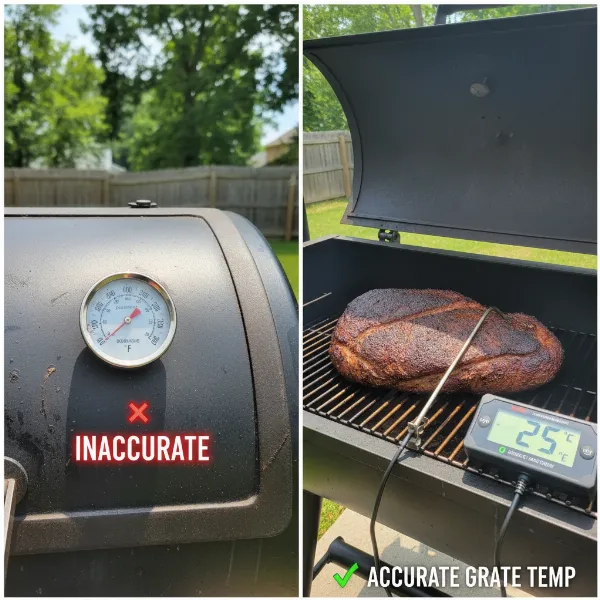 Smoker with inaccurate lid thermometer and accurate grate-level probe for temperature
Understanding Your Tools: Types of Probes for Smoker Ambient Temp
To accurately monitor your smoker’s ambient temperature, you need the right tools. Not all temperature probes are created equal, and understanding their strengths and weaknesses is key to choosing the best setup for your smoking needs.
Dedicated Ambient Air Probes (Wired)
|
Our Picks for the Best Meat thermometer in 2026
As an Amazon Associate I earn from qualifying purchases.
|
||
| Num | Product | Action |
|---|---|---|
| 1 | Professional Meat Thermometer - Instant Read Food Thermometer with Waterproof Design, Backlight, Hold/Min/Max Function - Cooking Thermometer for Grilling, BBQ, Kitchen Use |

|
| 2 | Meat Thermometer Digital with 1 Second Instant Read, Large LED Display, Food Thermometer |
|
| 3 | ThermoPro TP19H Digital Meat Thermometer for Cooking with Ambidextrous Backlit and Motion Sensing Kitchen Cooking Food Thermometer for BBQ Grill Smoker Oil Fry Candy Instant Read Thermometer |
|
| 4 | Meat Thermometer Digital, Instant Read Meat ThermometerI for Grill and Cooking, Waterproof Food Thermometer for Kitchen and Outside, BBQ, Turkey, Candy, Liquids, Beef |
|
| 5 | TempPro TP829 1000ft Wireless Meat Thermometer Digital for Grilling and Smoking, 4 Meat Probes Grill Thermometer for Outside Grill, BBQ Thermometer for Cooking Food Temperature (Previously ThermoPro) |
|
| 6 | ThermoPro TP03B Digital Meat Thermometer for Cooking, Instant Read Thermometer with Backlight, Kitchen Food Thermometer for Grill Smoker BBQ Oil Deep Fry Candy Bread Coffee with Pop-up Meat Probe |
|
| 7 | Alpha Grillers Meat Thermometer Digital - Instant Read Food Thermometer for Cooking and Grilling Gifts for Men Valentines Day Gifts for Him Her Mom Dad |
|
| 8 | 0.5 Sec Instant Read Meat Thermometer Digital with ±0.5℉ Precision, Food Thermometer for Cooking Kitchen Gadgets, Oven Grill Candy BBQ Essentials Accessories, Gifts for Him Dad Men Birthday, Red |
|
| 9 | Ultrean Digital Meat Thermometer for Cooking,Ultra-Fast Instant Read Food Thermometer with Backlight,Foldable Probe,Waterproof Kitchen Thermometer for BBQ,Grill,Fry,Oven,Candy Making |
|
| 10 | Meat Thermometer Digital - Instant Read Food Thermometer for Cooking Grilling, Candy, Air Fryer, Griddle Probe Kitchen Gadgets Essentials BBQ Accessories, Valentines Day Gifts for Him Her, Red |
|
Wired ambient air probes are specifically designed to measure the air temperature in your smoker. They typically feature a slender, durable tip and a heat-resistant cable that connects to a digital thermometer unit outside the smoker. These probes are generally highly accurate and provide real-time readings, allowing you to react quickly to temperature changes. Their design minimizes interference, giving you a truer sense of the cooking environment. Many pitmasters consider a high-quality wired ambient air probe an indispensable tool for serious smoking.
Wireless Probes with Ambient Sensors
The rise of wireless probes offers convenience, integrating both meat and ambient temperature sensing into a single, cable-free unit. However, a significant drawback can be the accuracy of their ambient sensors. Two primary phenomena often affect these readings:
- Heat Sink Effect: When a wireless probe is inserted into a cold piece of meat, the cold mass can draw heat away from the probe’s internal ambient sensor. This “heat sink” effect can cause the ambient reading to appear artificially lower than the actual air temperature around the meat, as the probe is trying to equilibrate with the colder meat rather than the hot air.
- Evaporative Cooling: As meat cooks, moisture evaporates from its surface, creating a localized cooler layer of air around it. If a wireless probe’s ambient sensor is too close to the meat, this evaporative cooling can further depress the ambient temperature reading, again leading to an inaccurate representation of the overall smoker environment.
While convenient, it’s crucial to be aware of these limitations when relying on wireless probes for ambient temperature. Some advanced wireless systems mitigate these issues, but dedicated wired ambient probes often offer superior accuracy for the pit temperature.
Using Meat Probes for Ambient Temperature
Many multi-probe thermometers come with several identical probes, primarily designed for internal meat temperature. Can you use one of these for ambient temperature? Yes, you can, and many people do successfully. The key is proper placement. When using a meat probe for ambient temperature, ensure it is not inserted into meat. Instead, secure it with a clip or suspend it in the air at grate level. While it might not be as finely tuned as a dedicated air probe, a quality meat probe can provide a reasonably accurate ambient reading when correctly positioned. However, be mindful of the “heat sink effect” if it’s placed too close to a large, cold cut of meat.
Precision Placement: Where to Position Your Ambient Probe
Accurate ambient temperature readings are only as good as your probe placement. Proper positioning ensures you’re measuring the temperature where your food is actually cooking, not some arbitrary hot or cold spot.
The “Grate Level” Rule: Why It’s Paramount
The golden rule for ambient probe placement is “grate level.” This means positioning your probe as close as possible to the cooking grate where your meat rests. Heat distribution in a smoker is rarely uniform, and significant temperature gradients can exist between the lid, the middle of the chamber, and the grate. By measuring at grate level, you’re monitoring the environment that your food directly experiences, which is critical for consistent results. Forget the lid thermometer; your grate-level probe is your true guide.
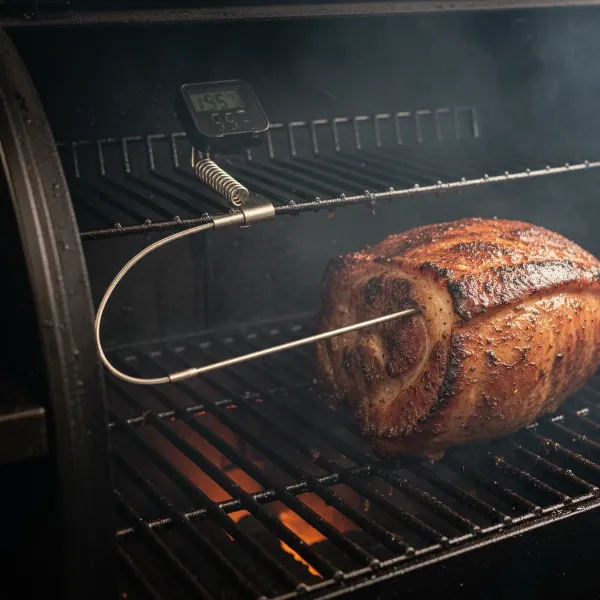 Digital temperature probe correctly positioned at grate level in a BBQ smoker
Optimal Distance from Meat and Walls
For the most accurate reading, your ambient probe should be suspended in the air, ideally 1 to 2 inches away from the meat itself, and not touching the grill grates or the smoker walls. Contact with cold meat can trigger the heat sink effect, providing an artificially low reading. Similarly, touching hot metal grates or walls can give an artificially high reading, as these surfaces often conduct and retain heat differently than the ambient air. Using a probe clip or even a small ball of aluminum foil to hold the probe steady and suspended is a common and effective technique.
The Importance of a Probe Port
Running probe cables through the smoker door gasket is a common mistake that can lead to two problems: damaging the probe cable and creating a gap in your smoker’s seal, resulting in smoke and heat loss. A dedicated probe port is a simple yet effective “hack” to solve this.
A probe port is typically a small, sealed opening (often a stainless steel cable gland) installed in the side of your smoker. This allows probe cables to pass cleanly into the cooking chamber without compromising the seal or damaging the wires. Installing one is a straightforward DIY project that greatly improves the efficiency and longevity of your probes and smoker. You can usually find stainless steel cable glands at hardware stores and install them with a drill and wrench. Position it on the cooler side of the smoker (away from the firebox) to protect the cables.
Troubleshooting and Calibration: Ensuring Your Readings are Spot On
Even with the best probes and placement, issues can arise. Knowing how to troubleshoot and calibrate your equipment ensures you always have trustworthy data.
Common Causes of Inaccurate Readings
Beyond poor placement or faulty lid thermometers, several factors can cause inaccurate probe readings:
- Smoker Hot Zones: Most smokers have inherent hot and cold spots due to airflow and heat source location. A single probe might accurately read its specific location, but not the entire smoker.
- Dirty Probes: Smoke residue and grease buildup on probes can act as insulation, slowing down response times and affecting accuracy.
- Damaged Probes: Kinked cables, moisture intrusion near the wire junction, or physical damage to the probe tip can lead to incorrect readings or complete failure.
- Altitude: The boiling point of water changes with altitude, which is important for calibration.
How to Calibrate Your Probes
Regular calibration is crucial to confirm your probes are reading accurately. The most common and reliable methods involve an ice bath and boiling water:
- Ice Bath Test: Fill a glass with crushed ice and add water until full. Stir for a minute, then insert your probe, ensuring it doesn’t touch the glass bottom or sides. A correctly calibrated probe should read 32°F (0°C).
- Boiling Water Test: Bring a pot of water to a rolling boil. Insert your probe, ensuring it’s submerged but not touching the bottom or sides of the pot. At sea level, a properly calibrated probe should read 212°F (100°C). Remember to adjust this temperature if you live at a higher altitude (e.g., in Denver, water boils around 202°F).
If your probe is consistently off by a few degrees, some thermometer units allow for manual calibration adjustment. If a probe is wildly inaccurate or inconsistent, it may be time for a replacement.
Cleaning Your Probes: Best Practices for Maintenance
Keeping your probes clean is essential for both accuracy and longevity. Smoke, grease, and food particles can build up, impairing their function.
- Gentle Cleaning: After each cook, allow probes to cool. Use warm, soapy water (dish soap like Dawn works well) and a soft sponge or cloth to wipe away residue.
- Stubborn Buildup: For more stubborn grime, a paste of baking soda and water, white vinegar, or rubbing alcohol can be effective. Some pitmasters swear by a “Magic Eraser” or balled-up aluminum foil for light scrubbing.
- Avoid Damage: Never immerse the cable-to-probe junction in water, as this can damage the internal wiring. Be careful not to bend or kink the probe cable, as this can break the internal wires. Avoid harsh abrasives like steel wool unless specifically recommended by the manufacturer, as they can scratch the probe’s surface.
Elevating Your Smoke Game: Advanced Tips with Ambient Probes
Once you’ve mastered the basics of ambient temperature monitoring, you can leverage your probes to unlock new levels of precision and control in your smoking.
Mapping Smoker Hot Zones with Multiple Probes
Every smoker has its unique thermal characteristics, often with “hot zones” and “cold zones.” By using multiple ambient probes placed at different locations on your cooking grates (e.g., front, back, left, right, upper, lower), you can create a thermal map of your smoker. Over several cooks, you’ll start to understand where the heat is most intense and where it’s cooler. This knowledge allows you to strategically position different cuts of meat for optimal cooking—placing larger, tougher cuts in hotter zones and more delicate items in cooler areas, or rotating food for even cooking.
Integrating with Temperature Controllers
For the ultimate “set it and forget it” experience, integrate your ambient probe with a temperature controller. These devices connect to your smoker’s air intake (typically with a small fan) and use the ambient probe’s readings to regulate the airflow, thereby precisely maintaining your target temperature. Many controllers also offer Wi-Fi connectivity, allowing you to monitor and adjust your smoker’s temperature from your smartphone, even when you’re away from home. This level of automation frees you from constantly babysitting your smoker, allowing you to focus on other tasks or simply relax.
Mastering Different Cook Types with Precise Ambient Control
Precise ambient temperature control is critical for various smoking techniques:
- Low & Slow: For cuts like brisket and pork butt, maintaining a consistent low temperature (e.g., 225-275°F) is essential for rendering fat and breaking down collagen. An accurate ambient probe prevents temperature spikes that can toughen meat or stall the cook prematurely.
- Reverse Sear: This technique involves smoking meat at a lower temperature until it’s almost done, then finishing with a high-heat sear. Accurate ambient probes help you hit the exact internal temperature before the sear, ensuring a perfect medium-rare steak.
- Poultry: Cooking poultry to the correct internal temperature while maintaining moistness requires careful ambient control to avoid drying out the meat or leaving it undercooked.
By truly understanding and managing your smoker’s internal climate with ambient probes, you gain the confidence to tackle any recipe and consistently produce exceptional results.
Conclusion
Mastering ambient temperature control in your smoker is not just an optional upgrade; it’s a fundamental shift that elevates your BBQ from good intentions to consistent, mouth-watering reality. By “hacking” your smoker with dedicated ambient probes and understanding optimal placement, you gain unparalleled insight into your cooking environment. Say goodbye to guesswork and unreliable lid thermometers, and embrace the precision that leads to perfectly cooked, juicy, and flavorful results every single time. It’s time to take control of your smoker’s internal climate and become the pitmaster you’ve always aspired to be. What culinary masterpiece will you create with your newly mastered smoker?
Frequently Asked Questions
Can I use a meat probe to measure ambient temperature?
Yes, you can use a meat probe for ambient temperature, but it’s crucial to ensure it’s not inserted into any food. Secure it with a probe clip or suspend it freely at grate level, about 1-2 inches away from your meat and smoker walls, to get a reasonably accurate reading of the air temperature.
How often should I calibrate my ambient probes?
It’s a good practice to calibrate your ambient probes periodically, especially if you suspect inaccurate readings or before important cooks. Calibrating every few months or after any significant impact or rough handling of the probe is generally recommended to ensure ongoing accuracy.
Why is my lid thermometer so different from my probe?
Lid thermometers are often positioned high in the smoker’s dome, far from the cooking grate where your food is. Since heat rises, these thermometers tend to read significantly higher than the actual temperature at grate level. Your grate-level probe provides a more accurate reading of the air surrounding your food.
What is the “heat sink effect” in smoking?
The “heat sink effect” occurs when a cold object, like a large piece of meat, draws heat away from a nearby temperature probe. If a probe’s ambient sensor is too close to cold meat, it will read an artificially lower temperature because the probe is attempting to equilibrate with the colder meat rather than the actual ambient air temperature.