The path to culinary excellence and food safety often feels shrouded in mystery, especially when it comes to judging if your dish is perfectly cooked. While visual cues might tempt you, the true secret lies in understanding and precisely measuring temperatures. Specifically, grasping the fundamental difference between surface temperature and internal temperature is paramount. This distinction isn’t just for professional chefs; it’s a vital piece of knowledge for every home cook aiming for both delectable results and assured food safety. This article will demystify these two crucial measurements, explain their importance, and guide you through the tools and techniques needed to master them in your kitchen.
Decoding the Core: What Are Surface and Internal Temperatures?
When we talk about food temperatures, we’re referring to two distinct measurements: surface temperature and internal temperature. Each plays a different role in the cooking process and dictates different aspects of your final product.
Surface temperature refers to the heat reading of the outermost layer of your food. This is the temperature exposed directly to the cooking environment—be it a hot pan, grill grate, or oven air. Factors such as the intensity of the heat source, the presence of moisture (through evaporative cooling, the surface can remain cooler than the cooking temperature), and the food’s composition can significantly influence this reading. It’s what creates the coveted crust on a steak or the golden-brown crispness of roasted vegetables.
In contrast, internal temperature is the heat measured at the very center, typically the thickest part of the food. This reading is the definitive indicator of how thoroughly cooked an item is throughout its core. It’s the “true” temperature that determines not only the doneness (e.g., rare, medium, well-done) but, more critically, whether potentially harmful bacteria have been eliminated, making the food safe to eat.
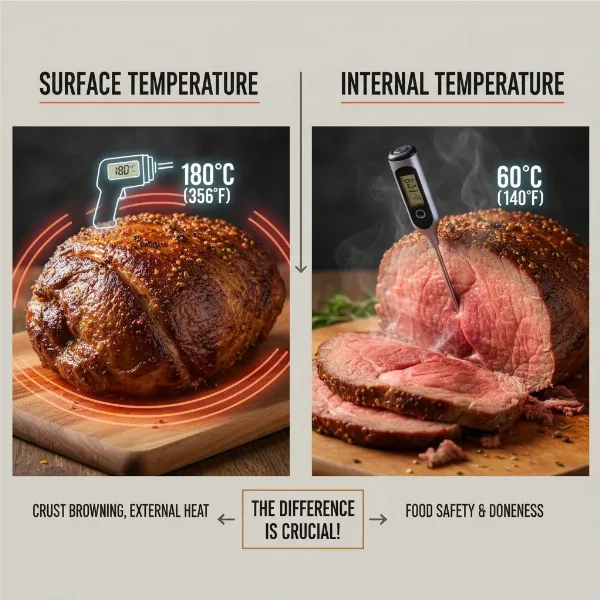 A visual guide illustrating the difference between surface and internal temperature in cooking food.
The Paramount Importance of Internal Temperature for Food Safety
For any cook, food safety should be the top priority. Achieving the correct internal temperature is the most reliable way to ensure the elimination of pathogenic microorganisms that can cause foodborne illnesses. Diseases caused by bacteria like Salmonella, Escherichia coli, Norovirus, and Campylobacter can be severe, and proper cooking is the last line of defense against them.
The most dangerous range for bacterial growth is known as the temperature danger zone, which spans from 40°F to 140°F (5°C to 60°C). Within this zone, bacteria can multiply rapidly, potentially doubling in as little as 20 minutes. Therefore, it is crucial to minimize the time food spends in this range, whether during cooking, cooling, or holding. Foods should not be left in the danger zone for more than two hours, or one hour if the ambient temperature is above 90°F.
Many home cooks rely on visual cues, such as the color of meat, to gauge doneness. However, color is an unreliable indicator for food safety. For instance, ground beef might appear brown and cooked on the outside, yet still harbor dangerous bacteria in its raw interior. Only an accurate internal temperature reading can confirm safety.
Here are some general USDA-recommended safe internal cooking temperatures:
- Whole Poultry (Chicken, Turkey, Duck): 165°F (74°C)
- Ground Meats (Beef, Pork, Lamb, Veal): 160°F (71°C)
- Beef, Pork, Lamb, Veal (Steaks, Chops, Roasts): 145°F (63°C) with a 3-minute rest time
- Fish and Shellfish: 145°F (63°C)
- Eggs and Egg Dishes: 160°F (71°C)
- Leftovers and Casseroles (Reheated): 165°F (74°C)
Precision in Practice: Tools and Techniques for Temperature Measurement
Accurate temperature measurement is a skill that elevates cooking from guesswork to an art. The right tools and proper techniques are indispensable for both safety and deliciousness.
Measuring Internal Temperature (Probe Thermometers)
For determining internal temperature, probe thermometers are your essential allies. These come in various forms, including:
- Instant-read thermometers: Provide quick readings, ideal for checking doneness at the end of cooking.
- Leave-in probe thermometers: Designed to stay in the food throughout the cooking process, often with an alarm to signal when the target temperature is reached.
- Digital thermometers: Offer clear, easy-to-read displays and fast measurements.
- Bimetallic thermometers: A more traditional, often less expensive option, but typically slower to read.
|
Our Picks for the Best Meat thermometer in 2026
As an Amazon Associate I earn from qualifying purchases.
|
||
| Num | Product | Action |
|---|---|---|
| 1 | Professional Meat Thermometer - Instant Read Food Thermometer with Waterproof Design, Backlight, Hold/Min/Max Function - Cooking Thermometer for Grilling, BBQ, Kitchen Use |

|
| 2 | Alpha Grillers Meat Thermometer Digital - Instant Read Food Thermometer for Cooking and Grilling Gifts for Men Valentines Day Gifts for Him Her Mom Dad |
|
| 3 | 0.5 Sec Instant Read Meat Thermometer Digital with ±0.5℉ Precision, Food Thermometer for Cooking Kitchen Gadgets, Oven Grill Candy BBQ Essentials Accessories, Gifts for Him Dad Men Birthday, Red |
|
| 4 | ThermoPro TP19H Digital Meat Thermometer for Cooking with Ambidextrous Backlit and Motion Sensing Kitchen Cooking Food Thermometer for BBQ Grill Smoker Oil Fry Candy Instant Read Thermometer |
|
| 5 | Meat Thermometer Digital with 1 Second Instant Read, Large LED Display, Food Thermometer |
|
| 6 | Ultrean Digital Meat Thermometer for Cooking,Ultra-Fast Instant Read Food Thermometer with Backlight,Foldable Probe,Waterproof Kitchen Thermometer for BBQ,Grill,Fry,Oven,Candy Making |
|
| 7 | Meat Thermometer Digital, Instant Read Meat ThermometerI for Grill and Cooking, Waterproof Food Thermometer for Kitchen and Outside, BBQ, Turkey, Candy, Liquids, Beef |
|
| 8 | ThermoPro TP03B Digital Meat Thermometer for Cooking, Instant Read Thermometer with Backlight, Kitchen Food Thermometer for Grill Smoker BBQ Oil Deep Fry Candy Bread Coffee with Pop-up Meat Probe |
|
| 9 | TempPro TP829 1000ft Wireless Meat Thermometer Digital for Grilling and Smoking, 4 Meat Probes Grill Thermometer for Outside Grill, BBQ Thermometer for Cooking Food Temperature (Previously ThermoPro) |
|
| 10 | Meat Thermometer Digital - Instant Read Food Thermometer for Cooking Grilling, Candy, Air Fryer, Griddle Probe Kitchen Gadgets Essentials BBQ Accessories, Valentines Day Gifts for Him Her, Red |
|
Proper Insertion: To get an accurate reading, insert the thermometer probe into the thickest part of the food, ensuring it avoids bone, fat, or gristle, which can give false readings. For solid foods, aim for at least 0.5 inches deep. For liquids, dip the probe at least a quarter of the way from the bottom of the container. Always wait for the temperature reading to stabilize before recording.
Calibration: Regular calibration of your thermometer is crucial for its accuracy. You can perform this using an ice-bath method (a mixture of crushed ice and water should read 32°F / 0°C) or a boiling-water method (boiling water should read 212°F / 100°C at sea level). Calibration ensures your thermometer is always giving you the true temperature.
Measuring Surface Temperature (Infrared Thermometers)
Infrared (IR) thermometers operate on a non-contact principle, using infrared technology to measure the temperature of a surface. They are excellent for specific kitchen tasks:
- Preheating pans and griddles: Achieving the ideal surface temperature (e.g., 400-450°F for searing steaks, 375°F for pancakes) prevents scorching or ensures a perfect crust.
- Wok cooking: Ensuring very high, consistent heat for proper stir-frying.
- Checking grill grates: Confirming your grill is adequately hot before placing food.
Limitations: It’s vital to understand that infrared thermometers are not suitable for measuring the internal doneness or safety of food. They only read the surface, and that surface temperature can be drastically different from the core. Their accuracy can also be affected by the emissivity (reflectivity) of the surface being measured, meaning shiny stainless steel might yield less accurate results than a cast-iron pan.
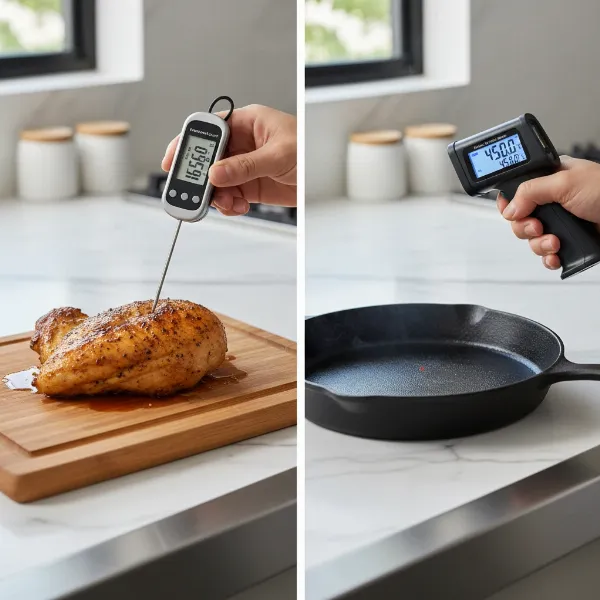 Different types of cooking thermometers and their proper application in the kitchen.
Avoiding Pitfalls: Common Mistakes and Best Practices
Even with the right tools, misapplication can lead to subpar or unsafe results. Avoiding common mistakes is key to becoming a confident cook.
Mistakes to Avoid:
- Relying on guesswork or visual signs: As established, color and appearance are deceptive. A thermometer is your only true guide.
- Incorrect thermometer placement: Inserting the probe too shallow, against a bone, or into a pocket of fat can give an artificially high or low reading.
- Ignoring “carry-over cooking”: This phenomenon occurs when food continues to cook and its internal temperature rises even after being removed from the heat source. For large cuts of meat, this rise can be significant (5-15°F), leading to overcooked food if not accounted for.
- Neglecting thermometer calibration: An uncalibrated thermometer is an unreliable one, potentially leading to undercooked (unsafe) or overcooked food.
Best Practices:
- Always use a calibrated probe thermometer for checking internal food temperatures, especially for meats and poultry.
- Understand and follow specific temperature guidelines for different foods to ensure both safety and desired doneness.
- Practice good food hygiene diligently. This includes frequent handwashing, using separate cutting boards and utensils for raw and cooked foods to prevent cross-contamination, and proper cleaning of all cooking surfaces and thermometers.
- Monitor cooking and holding times. This helps ensure food doesn’t spend too long in the temperature danger zone.
“The true measure of a cooked dish isn’t its appearance, but its internal temperature. It’s the silent guardian of food safety and the secret to culinary perfection.” – Chef Antoine Dubois, Culinary Instructor and Food Safety Expert
Mastering Your Cook: Achieving Perfect Results
Understanding surface and internal temperatures empowers you to truly master your cooking. The interplay between these two temperatures defines the texture, juiciness, and overall success of your dishes.
Temperature and Texture: Controlling the internal temperature allows you to achieve specific levels of doneness that directly impact the texture and juiciness of meats. For example, cooking a steak to a precise medium-rare (130-135°F / 54-57°C) ensures a tender, juicy interior, whereas overcooking it to well-done will result in a dry, tough texture. The higher surface temperature creates a flavorful crust through the Maillard reaction, while the carefully managed internal temperature preserves the succulence within.
Resting Meats: The concept of carry-over cooking is directly tied to the difference between surface and internal temperatures. When you remove a large roast or steak from the oven or grill, the hotter exterior continues to transfer heat to the cooler interior, causing the internal temperature to rise. Resting meat allows this heat to redistribute evenly, resulting in a more uniformly cooked and juicier product. If you cook to your target temperature without accounting for carry-over, your meat will likely be overcooked. For example, if you aim for 145°F, you might remove the meat when it reaches 140°F, letting it rest to reach the final desired temperature.
Applying Knowledge: With this understanding, you can strategically use both types of temperature measurements. Start with a high surface temperature (monitored with an IR thermometer) to achieve a beautiful sear on a piece of meat, then transfer it to a lower heat environment (like an oven) and rely on a probe thermometer to bring it to its precise internal doneness. This two-pronged approach guarantees both aesthetic appeal and culinary perfection.
Conclusion
The distinction between surface and internal temperature is more than just a technicality; it’s a cornerstone of confident and safe cooking. While surface temperature offers insights into crust development and searing potential, it’s the internal temperature that stands as the ultimate arbiter of food safety and doneness. Equipping your kitchen with a reliable, calibrated probe thermometer and understanding its proper use will transform your cooking. By embracing precision, you eliminate guesswork, prevent foodborne illnesses, and consistently produce meals that are not only safe but also perfectly cooked and bursting with flavor. Invest in accuracy, and you invest in every meal you prepare.
What culinary masterpiece will you perfect next with your newfound temperature expertise?
Frequently Asked Questions
What is the “temperature danger zone” in cooking?
The “temperature danger zone” is the range between 40°F and 140°F (5°C and 60°C) where bacteria multiply most rapidly. Foods should be kept out of this zone as much as possible, ideally for no more than two hours, to prevent the growth of harmful pathogens.
Why can’t I just look at the color of meat to tell if it’s done?
Relying on visual cues like meat color is unreliable for determining doneness and safety. Meat can appear cooked on the outside while still being undercooked and potentially unsafe in the center. Only an accurate internal temperature reading ensures proper cooking.
Can I use an infrared thermometer to check if my chicken is cooked?
No, an infrared thermometer is not suitable for checking if your chicken (or any meat) is cooked safely. It only measures the surface temperature, which can be significantly different from the internal temperature. Always use a probe thermometer for internal doneness.
How does “carry-over cooking” affect the final temperature of my roast?
Carry-over cooking means that food continues to cook and its internal temperature rises after being removed from the heat source. For roasts, this can cause the temperature to increase by 5-15°F, so you should remove the roast from the oven a few degrees below your target temperature.
How often should I calibrate my meat thermometer?
You should calibrate your meat thermometer regularly, especially when it’s new, if it’s been dropped, if it hasn’t been used for a long time, or if you suspect it’s inaccurate. A simple ice-bath or boiling-water method can confirm its precision.
What’s the best type of thermometer for checking internal meat temperature?
For checking internal meat temperature, an instant-read digital probe thermometer is highly recommended. It offers speed, accuracy, and ease of use, making it ideal for quickly verifying doneness in various cuts of meat without overcooking.