Introduction:
- Hook: Cooking multiple items or large roasts to perfection simultaneously often presents a significant challenge for home chefs.
- Introduce multi-probe thermometers as the solution for precision and convenience: These innovative tools offer a reliable way to monitor internal temperatures with accuracy, transforming complex culinary tasks into stress-free experiences.
- Briefly state what the article will cover: This article will delve into understanding multi-probe thermometers, guide you through selecting the best one, review top products, offer usage tips, and share culinary advice to elevate your cooking.
Mastering Multi-Course Meals: Understanding Multi-Probe Thermometers
|
Our Picks for the Best Meat thermometer in 2026
As an Amazon Associate I earn from qualifying purchases.
|
||
| Num | Product | Action |
|---|---|---|
| 1 | Ultrean Digital Meat Thermometer for Cooking,Ultra-Fast Instant Read Food Thermometer with Backlight,Foldable Probe,Waterproof Kitchen Thermometer for BBQ,Grill,Fry,Oven,Candy Making |

|
| 2 | ThermoPro TP19H Digital Meat Thermometer for Cooking with Ambidextrous Backlit and Motion Sensing Kitchen Cooking Food Thermometer for BBQ Grill Smoker Oil Fry Candy Instant Read Thermometer |
|
| 3 | TempPro TP829 1000ft Wireless Meat Thermometer Digital for Grilling and Smoking, 4 Meat Probes Grill Thermometer for Outside Grill, BBQ Thermometer for Cooking Food Temperature (Previously ThermoPro) |
|
| 4 | 0.5 Sec Instant Read Meat Thermometer Digital with ±0.5℉ Precision, Food Thermometer for Cooking Kitchen Gadgets, Oven Grill Candy BBQ Essentials Accessories, Gifts for Him Dad Men Birthday, Red |
|
| 5 | Meat Thermometer Digital, Instant Read Meat ThermometerI for Grill and Cooking, Waterproof Food Thermometer for Kitchen and Outside, BBQ, Turkey, Candy, Liquids, Beef |
|
| 6 | Meat Thermometer Digital - Instant Read Food Thermometer for Cooking Grilling, Candy, Air Fryer, Griddle Probe Kitchen Gadgets Essentials BBQ Accessories, Valentines Day Gifts for Him Her, Red |
|
| 7 | Meat Thermometer Digital with 1 Second Instant Read, Large LED Display, Food Thermometer |
|
| 8 | Professional Meat Thermometer - Instant Read Food Thermometer with Waterproof Design, Backlight, Hold/Min/Max Function - Cooking Thermometer for Grilling, BBQ, Kitchen Use |
|
| 9 | ThermoPro TP03B Digital Meat Thermometer for Cooking, Instant Read Thermometer with Backlight, Kitchen Food Thermometer for Grill Smoker BBQ Oil Deep Fry Candy Bread Coffee with Pop-up Meat Probe |
|
| 10 | Alpha Grillers Meat Thermometer Digital - Instant Read Food Thermometer for Cooking and Grilling Gifts for Men Valentines Day Gifts for Him Her Mom Dad |
|
- What is a Multi-Probe Thermometer?
- A multi-probe thermometer is an electronic device equipped with multiple temperature sensors (probes) designed to monitor the internal temperature of several food items or ambient temperatures concurrently. It differs from an instant-read thermometer, which provides a quick, single reading, by offering continuous, simultaneous monitoring over extended periods.
- Its core function is the simultaneous monitoring of multiple temperatures, allowing for precise control over the cooking process of various dishes at once.
- Why You Need a Multi-Probe Thermometer for Entire Meals:
- Ensuring uniform doneness across different meats: Whether you’re cooking a Thanksgiving turkey and a ham, or steaks to different doneness levels, multi-probe thermometers allow you to achieve perfect results for each item.
- Monitoring ambient temperature for consistent cooking (smokers, ovens): Beyond food, some probes can monitor the temperature inside your smoker or oven, crucial for maintaining a stable cooking environment, especially for low-and-slow methods.
- Food safety: Accurately reaching safe internal temperatures for meats prevents foodborne illnesses, providing peace of mind.
- Reduced stress and hands-free cooking: Instead of constantly opening the oven or grill, you can monitor temperatures remotely, freeing you to focus on other tasks or enjoy your guests.
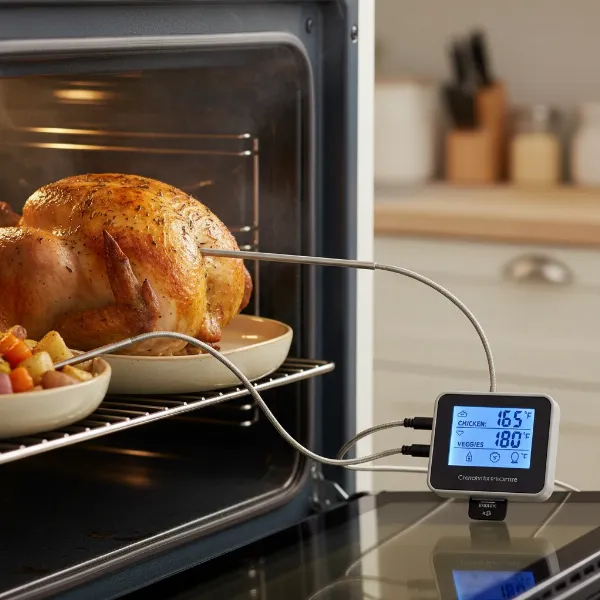 Multi-probe thermometer monitoring a roast chicken and a side dish in an oven.
- Types of Multi-Probe Thermometers:
- Wired multi-probe: These are traditional models where probes are connected via heat-resistant wires to a base unit. They generally offer robust connectivity and are often simpler in design.
- Wireless multi-probe: These utilize technologies like Bluetooth or Wi-Fi to transmit temperature data wirelessly from the probes to a base unit or a smartphone app. Fully wire-free probes (like some MEATER models) offer ultimate flexibility, while others have wireless connectivity between the base unit and your smart device.
Choosing Your Culinary Companion: Factors for Selecting a Multi-Probe Thermometer
- Number of Probes and Channels:
- Consider how many dishes you typically cook simultaneously. Two probes are sufficient for a dual cook, but four or more channels are ideal for complex meals, large roasts with multiple temperature zones, or extensive smoking sessions.
- Look for models that offer a combination of food probes and dedicated ambient probes for monitoring oven or smoker temperatures.
- Connectivity and Range:
- Bluetooth vs. Wi-Fi: Bluetooth models offer good local range but are limited, while Wi-Fi connected thermometers can provide monitoring from virtually anywhere with an internet connection, often with more advanced app features.
- The importance of effective range varies depending on your cooking environment and how far you need to be from your cooker.
- Accuracy and Speed:
- Precision is a non-negotiable feature for any good thermometer. Look for devices known for their accuracy.
- Understand the difference in speed: leave-in probes are designed for continuous monitoring and might not be as “instant” as a dedicated instant-read thermometer, but they should provide updates frequently enough for effective oversight.
- Durability and Design:
- Probe materials: Probes should be made from high-quality stainless steel for longevity and food safety.
- Cable heat resistance: For wired models, ensure cables can withstand high cooking temperatures without degradation.
- Water resistance (IP ratings): A good IP rating (e.g., IP67) indicates resistance to splashes and brief immersion, making cleaning easier and preventing damage.
- Ergonomics of the base unit and probes: A user-friendly design, clear display, and comfortable handling are important for ease of use.
- App Integration and Features:
- A well-designed app can significantly enhance the user experience, offering a user-friendly interface, preset temperatures for various meats, custom alarms, and data logging capabilities to track cooking history.
- Remote monitoring via an app allows you to keep an eye on your food from another room or even while running errands.
- Battery Life and Power:
- For long cooks like smoking briskets or whole turkeys, excellent battery life is crucial. Consider whether the device uses rechargeable batteries (often via USB) or easily replaceable standard batteries.
Top Picks for Multi-Probe Thermometers: A Comparative Look
Table comparing 4-5 top products, including:
- Product Name
- Key Features (Number of Probes, Wireless Type, Special Features)
- Pros
- Cons
- Price Range (General indication)
Products to include in the table and detailed review:
- ThermoWorks Signals (4-channel, Wi-Fi/Bluetooth)
- ChefsTemp Quad XPro (4-channel, wired multi-probe, wireless range)
- Meater Pro (Wireless, app-only, single probe but representing advanced wireless tech often used in multi-probe setups like Meater Block, deep fry capable)
- Typhur Sync (Dual probe, good display, app-connected)
- ThermoPro Twin TempSpike (Budget wireless dual, Wi-Fi booster in base)
- FireBoard 2 (Up to 6 probes, Bluetooth, stable connectivity)
In-Depth Reviews of Leading Multi-Probe Thermometers
Detailed review for each product from the table, covering:
- Design and Build Quality
- Accuracy and Performance
- Unique Features and Functionality (e.g., app, alarms, ambient temp)
- Durability and Longevity
- Ease of Use and Cleaning
Getting the Most Out of Your Multi-Probe Thermometer: Usage and Care
- Proper Probe Placement:
- Always insert the probe into the thickest part of the meat, ensuring it avoids bone, gristle, or large pockets of fat, as these can give inaccurate readings.
- For very large cuts, consider using multiple probes in different locations to ensure even cooking throughout.
- Place ambient probes strategically to accurately measure the air temperature inside your oven, grill, or smoker, typically away from direct heat sources and food.
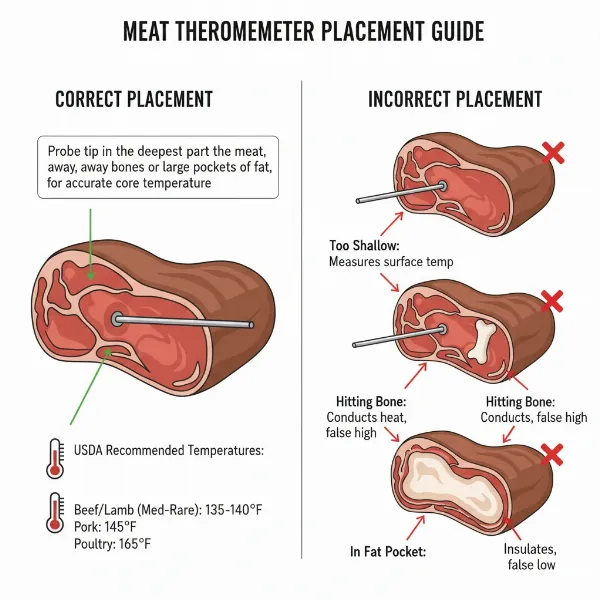 Diagram showing correct and incorrect probe placement in a large cut of meat.
- Setting Up and Using the App:
- Most wireless multi-probe thermometers require an initial pairing process with their dedicated smartphone app. Follow the instructions to connect.
- Once connected, you can set custom high/low temperature alarms, select preset meat temperatures, and monitor temperature trends over time, which can be invaluable for understanding your cooking process.
- Calibration for Precision:
- Ice bath method: To ensure your thermometer is accurate, perform an ice bath calibration. Fill a glass with crushed ice and water, let it sit for a few minutes, then insert the probe. It should read 32°F (0°C).
- Why it’s important: Regular calibration ensures your readings are consistently reliable, preventing undercooked or overcooked food.
- Cleaning and Storage:
- Always hand wash probes with soap and water after each use. Avoid immersing the probe’s cable connection or the base unit in water.
- Wipe down the base unit with a damp cloth.
- Store probes with care, avoiding sharp bends in the cables, and keep the base unit in a dry, protected place to prolong its lifespan.
- Common Issues and Troubleshooting:
- Connectivity drops: Check battery levels, ensure you’re within range, and try re-pairing the device. Obstructions can also interfere with wireless signals.
- Inaccurate readings: Recalibrate the probe, check for proper placement in the meat, and ensure probes are fully inserted.
- Battery issues: Ensure batteries are charged or replaced regularly, especially before long cooks.
Elevate Your Cooking: Culinary Tips with Multi-Probe Thermometers
- Achieving Perfect Doneness:
- Refer to internal temperature guides for various meats (e.g., chicken: 165°F, beef medium-rare: 130-135°F, pork: 145°F, turkey: 165°F).
- Understanding carry-over cooking: Remember that meats continue to cook after being removed from the heat. Account for this “carry-over” by removing your food a few degrees below the desired final temperature.
- Smoking and BBQ Perfection:
- Maintain consistent pit temperature by monitoring ambient probe readings and adjusting vents or fuel as needed.
- Monitoring meat stalls: For long smoking sessions, observe when the meat’s internal temperature plateaus (the “stall”) and plan accordingly, often pushing through this phase with patience.
- Roasting Large Cuts:
- Use multiple probes to ensure even cooking throughout large roasts, preventing one part from being overcooked while another is undercooked.
- Recipe Ideas: Use your multi-probe thermometer to perfect roast chicken, prime rib, smoked brisket, pulled pork, and more.
Conclusion:
- Recap benefits of multi-probe thermometers: Multi-probe thermometers are indispensable tools for achieving culinary precision, offering unparalleled convenience, accuracy, and peace of mind when cooking complex meals or large cuts of meat.
- Reiterate their value for home cooks: They transform daunting cooking tasks into enjoyable, stress-free experiences, guaranteeing perfect results every time.
- Call to Action: Invest in a high-quality multi-probe thermometer today to elevate your cooking game and confidently tackle any recipe.
- Open Question: “What culinary masterpiece will you tackle next with your new multi-probe thermometer?”
Frequently Asked Questions
- How many probes do I really need?
It depends on your cooking habits. Two probes are good for basic dual cooks, but 4+ are recommended for serious smokers or multi-course meals. - Can I use a wireless thermometer in a closed grill/oven?
Yes, most are designed for this. Fully wireless probes sit entirely inside the cooker, while wired probes feed wires out through small gaps. - How do I know if my thermometer is accurate?
Perform an ice bath calibration (probe should read 32°F/0°C). If it’s off by more than a degree or two, it may need recalibration or replacement. - What’s the difference between wired and wireless probes?
Wired probes connect directly to a base unit via a cable. Wireless probes transmit data without physical wires, either from the probe to a base or directly to an app. Wireless offers more freedom but can have connectivity challenges. - Can multi-probe thermometers measure liquids or baked goods?
Yes, they can measure liquids. For baked goods, while possible, an instant-read thermometer is often more practical for a quick check.