Achieving culinary perfection often hinges on one crucial element: temperature. Whether you’re a seasoned chef or a home cook aspiring to elevate your dishes, accurately gauging heat can make the difference between a perfectly cooked meal and a disappointing one. The modern kitchen offers an array of tools for this task, primarily categorizing into two distinct types: infrared thermometers and probe thermometers. While both aim to measure temperature, their methods, applications, and optimal uses differ significantly, leading many to wonder which is truly best for their needs. This article will delve into the distinct functionalities of these essential kitchen gadgets, helping you understand their unique strengths and guiding you toward making an informed choice for precision cooking.
Infrared Thermometers vs. Probe Thermometers: Understanding the Core Difference
The fundamental distinction between infrared and probe thermometers lies in what they measure and how they measure it. Understanding this core difference is paramount to selecting the right tool for the job.
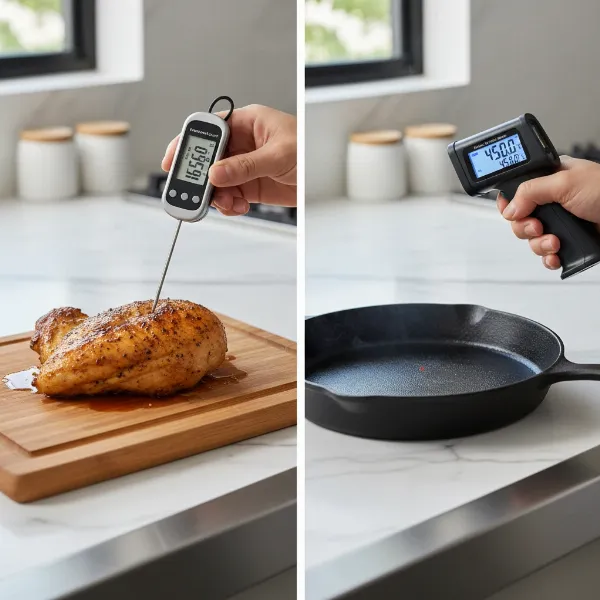
A probe thermometer is a traditional tool featuring a thin metal shaft designed to be inserted directly into food or liquid. It measures the internal temperature, providing a precise reading of the core heat. This direct contact method makes it invaluable for assessing the doneness of thick cuts of meat, baked goods, or the exact temperature of simmering sauces.
In contrast, an infrared thermometer, often resembling a “temperature gun,” measures surface temperature without any physical contact. It detects the infrared energy emitted by an object and translates it into a temperature reading on its display. This non-contact approach offers instant results, making it ideal for quick checks of hot surfaces or liquids where direct immersion is impractical or unsafe.
The key takeaway is this: a probe thermometer provides the critical internal temperature for food safety and doneness, while an infrared thermometer offers rapid surface temperature assessment, useful for controlling cooking environments.
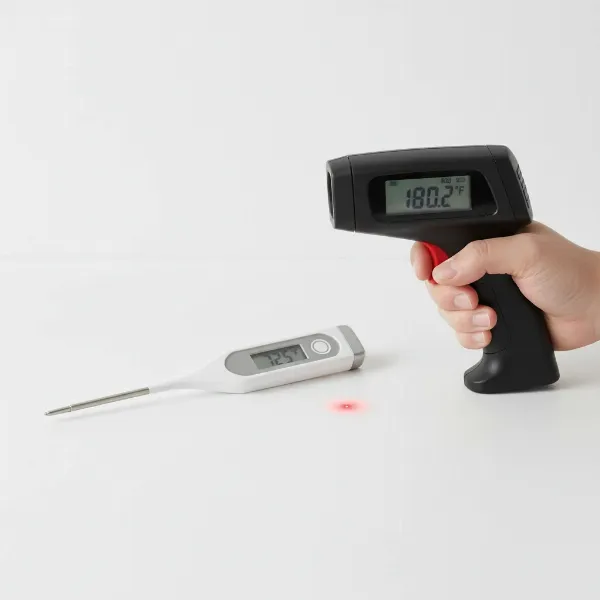 Side-by-side comparison of a digital probe thermometer and an infrared temperature gun for cooking.
Probe Thermometers: Precision for Perfect Doneness
Probe thermometers are the cornerstone of accurate internal temperature measurement in cooking. Their design allows them to penetrate the core of an item, providing the most reliable readings for determining doneness and ensuring food safety.
The primary advantages of probe thermometers include their exceptional accuracy for internal temperatures and their versatility across various cooking applications. They are indispensable for verifying that foods, especially meats and poultry, have reached safe minimum internal temperatures to eliminate harmful bacteria. Furthermore, probe thermometers are perfect for monitoring the precise temperature of liquids like deep-fry oil, candy syrups, or tempered chocolate, where a few degrees can drastically alter the final product.
However, probe thermometers do have some disadvantages. They require direct physical contact, meaning you must insert the probe into the food, which can pierce delicate items or release juices from meats. Readings are also typically slower, often taking several seconds to stabilize. Additionally, the probe must be thoroughly cleaned and sanitized after each use to prevent cross-contamination.
Best uses for probe thermometers include:
- Checking the internal temperature of roasts, steaks, poultry, and fish.
- Monitoring the doneness of bread, cakes, and other baked goods.
- Gauging the temperature of oils for deep-frying or caramel for candy making.
- Ensuring casseroles and leftovers are reheated to a safe internal temperature.
There are several types of probe thermometers, including instant-read digital thermometers, which offer quick readings when inserted; leave-in probe thermometers, designed to remain in food during cooking (often with a wired connection to an external display); and more advanced wireless versions that connect to apps for remote monitoring.
Infrared Thermometers: Speed and Safety for Surface Control
Infrared thermometers bring a unique set of benefits to the kitchen, primarily centered around speed, safety, and non-contact measurement of surface temperatures.
The key advantages of infrared thermometers are their non-contact nature, instant readings, and hygienic operation. Since they don’t touch the surface they’re measuring, there’s no risk of cross-contamination, making them excellent for commercial kitchens or quick checks between different food items. Their ability to measure from a distance enhances safety, particularly when dealing with extremely hot surfaces like grills, ovens, or deep fryers. This speed and safety make them incredibly convenient for tasks requiring rapid temperature assessment.
Despite these benefits, infrared thermometers come with notable disadvantages. Crucially, they only measure surface temperature, meaning they cannot tell you the internal doneness of a piece of meat. Factors like surface reflectivity (emissivity), distance from the object, and environmental conditions can also affect the accuracy of the reading. Therefore, relying solely on an infrared thermometer for food safety is not recommended.
Best uses for infrared thermometers include:
- Verifying the preheating temperature of grill grates, cast iron pans, and pizza stones.
- Checking the surface temperature of cooking oils in a pan.
- Monitoring the exterior temperature of ovens or fryers.
- Quickly assessing the temperature of chocolate for tempering or caramel for consistency.
- Confirming the temperature of food held in chafing dishes or buffet lines.
Choosing the Right Tool: When to Use Which
The decision between an infrared thermometer and a probe thermometer isn’t about one being inherently “better” than the other, but rather about choosing the right tool for the specific task at hand. Often, the most effective approach involves leveraging the strengths of both.
For food safety, a probe thermometer is absolutely essential. It is the only reliable method for confirming that foods, especially meats and poultry, have reached a safe internal temperature to destroy harmful bacteria. An infrared thermometer cannot provide this critical information.
For cooking surfaces and liquids, an infrared thermometer excels. If you need to know if your grill is hot enough for searing, if your pan has reached the ideal temperature for a perfect crust, or the surface temperature of your deep-fry oil, the speed and non-contact convenience of an infrared thermometer are unparalleled.
The “smart chef” approach often involves using both. Imagine grilling a steak: you might use an infrared thermometer to quickly check the temperature of your grill grates to ensure they’re hot enough for a good sear. Once the steak is on, you’d then rely on a probe thermometer inserted into the thickest part of the meat to monitor its internal temperature, ensuring it reaches your desired level of doneness, from rare to well-done, and most importantly, is safe to eat.
When making your selection, consider your primary cooking tasks, your need for internal versus surface temperature data, and any specific safety requirements. Your budget and desired features, such as speed of reading or connectivity, will also play a role.
Maximizing Your Cooking with Both Thermometers
Embracing both infrared and probe thermometers in your kitchen arsenal can unlock new levels of precision and confidence in your cooking. They are complementary tools, each filling a vital role in achieving culinary excellence.
For example, when making a delicate dish like homemade candy, an infrared thermometer can quickly check the surface temperature of the molten sugar, giving you an immediate, non-invasive read on whether it’s nearing the critical stages. Then, a precise probe thermometer can be dipped in to confirm the exact internal temperature needed for soft ball, firm ball, or hard crack stages.
Another prime scenario is roasting. You might use an infrared thermometer to monitor the internal temperature of your oven to ensure it’s consistent throughout the roasting process. Simultaneously, a leave-in probe thermometer, inserted into your roast, provides continuous, real-time feedback on the meat’s internal progression, allowing you to pull it from the oven at the precise moment it reaches perfect doneness. This dual approach ensures both the cooking environment and the food itself are at their optimal temperatures.
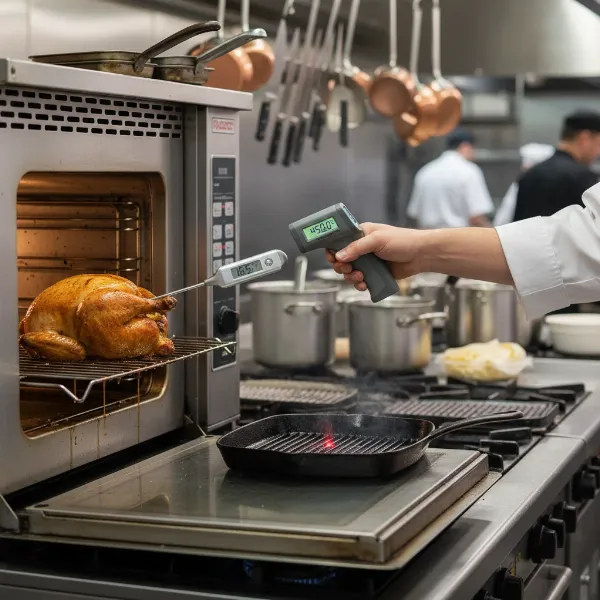 Chef using both a probe thermometer in meat and an infrared thermometer on a pan in a kitchen.
Remember to calibrate your thermometers regularly, especially probe thermometers, to maintain accuracy. Clean your probe thermometer thoroughly after each use, while infrared thermometers generally only require wiping down the exterior.
Conclusion
The debate between infrared thermometers and probe thermometers isn’t about which is definitively superior, but rather understanding their unique applications. Probe thermometers are indispensable for measuring internal temperatures, ensuring food safety, and achieving precise doneness in meats, baked goods, and liquids. Infrared thermometers, with their non-contact and instant readings, are perfect for rapidly assessing surface temperatures of cooking equipment and hot liquids, enhancing safety and efficiency. For the most versatile and precise cooking experience, many culinary experts recommend having both tools at your disposal. By using each thermometer for its intended purpose, you gain comprehensive temperature control, transforming your cooking and consistently delivering delicious, perfectly prepared meals. Which thermometer will you reach for first to elevate your next culinary creation?
Frequently Asked Questions
Can I use an infrared thermometer to check if meat is cooked through?
|
Our Picks for the Best Meat thermometer in 2026
As an Amazon Associate I earn from qualifying purchases.
|
||
| Num | Product | Action |
|---|---|---|
| 1 | Meat Thermometer Digital - Instant Read Food Thermometer for Cooking Grilling, Candy, Air Fryer, Griddle Probe Kitchen Gadgets Essentials BBQ Accessories, Valentines Day Gifts for Him Her, Red |

|
| 2 | ThermoPro TP19H Digital Meat Thermometer for Cooking with Ambidextrous Backlit and Motion Sensing Kitchen Cooking Food Thermometer for BBQ Grill Smoker Oil Fry Candy Instant Read Thermometer |
|
| 3 | TempPro TP829 1000ft Wireless Meat Thermometer Digital for Grilling and Smoking, 4 Meat Probes Grill Thermometer for Outside Grill, BBQ Thermometer for Cooking Food Temperature (Previously ThermoPro) |
|
| 4 | Meat Thermometer Digital, Instant Read Meat ThermometerI for Grill and Cooking, Waterproof Food Thermometer for Kitchen and Outside, BBQ, Turkey, Candy, Liquids, Beef |
|
| 5 | Ultrean Digital Meat Thermometer for Cooking,Ultra-Fast Instant Read Food Thermometer with Backlight,Foldable Probe,Waterproof Kitchen Thermometer for BBQ,Grill,Fry,Oven,Candy Making |
|
| 6 | Alpha Grillers Meat Thermometer Digital - Instant Read Food Thermometer for Cooking and Grilling Gifts for Men Valentines Day Gifts for Him Her Mom Dad |
|
| 7 | 0.5 Sec Instant Read Meat Thermometer Digital with ±0.5℉ Precision, Food Thermometer for Cooking Kitchen Gadgets, Oven Grill Candy BBQ Essentials Accessories, Gifts for Him Dad Men Birthday, Red |
|
| 8 | Meat Thermometer Digital with 1 Second Instant Read, Large LED Display, Food Thermometer |
|
| 9 | ThermoPro TP03B Digital Meat Thermometer for Cooking, Instant Read Thermometer with Backlight, Kitchen Food Thermometer for Grill Smoker BBQ Oil Deep Fry Candy Bread Coffee with Pop-up Meat Probe |
|
| 10 | Professional Meat Thermometer - Instant Read Food Thermometer with Waterproof Design, Backlight, Hold/Min/Max Function - Cooking Thermometer for Grilling, BBQ, Kitchen Use |
|
No, an infrared thermometer only measures the surface temperature of food. It cannot accurately determine the internal temperature, which is crucial for ensuring meat is safely cooked and reaches the correct doneness. For internal doneness, a probe thermometer is essential.
How accurate are infrared thermometers for cooking?
Infrared thermometers are generally accurate for surface temperature readings, typically within ±1-2°C. However, their accuracy can be affected by factors like surface reflectivity, the distance from the object, and steam. They are not as accurate as probe thermometers for measuring internal food temperatures.
Is it safe to use an infrared thermometer on food?
Yes, it is safe to use an infrared thermometer on food because it is a non-contact device. It measures emitted infrared energy and does not contaminate the food. This makes it a hygienic option for quick surface checks.
Why do professional chefs often use both types of thermometers?
Professional chefs often use both infrared and probe thermometers to gain complete temperature control. They use infrared for quick, non-contact checks of cooking surfaces (like pans or grills) and oils, and probe thermometers for precise internal temperature readings of food to ensure doneness and safety.
What is emissivity and how does it affect infrared thermometer readings?
Emissivity is an object’s efficiency in emitting thermal energy as infrared radiation. Different materials have different emissivities. If an infrared thermometer’s emissivity setting doesn’t match the surface being measured, it can lead to inaccurate readings. Many models allow for adjustable emissivity.