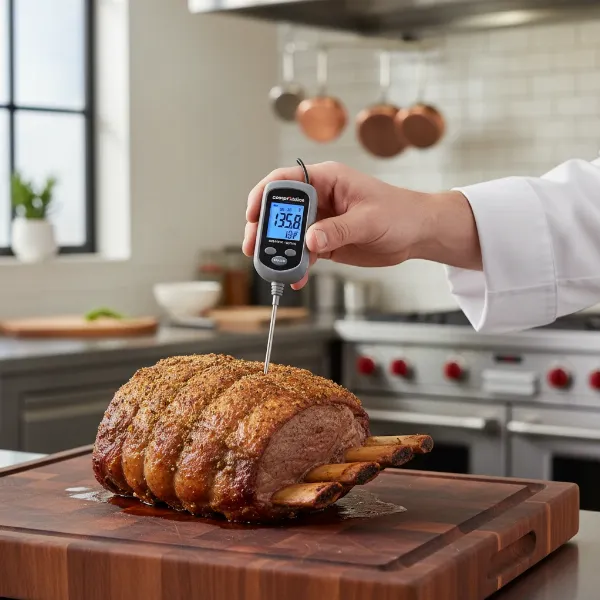
Achieving perfectly cooked meat can feel like a culinary tightrope walk. Is it done? Is it overcooked? Under-cooked? For home cooks and grill masters alike, the secret to consistently delicious and safe results lies in one indispensable tool: the meat thermometer. But with a variety of options available, particularly the popular leave-in and handheld models, choosing the right one can be daunting. Understanding the distinct advantages and limitations of each is crucial to elevate your cooking, ensuring every cut of meat reaches its peak of tenderness and flavor.
Meat Thermometers: Overview and Benefits
A meat thermometer is a device used to measure the internal temperature of cooked meat, poultry, and other food items. It helps ensure food safety by confirming that pathogens have been destroyed, and it prevents overcooking, guaranteeing optimal texture and juiciness. Relying solely on cooking time or visual cues often leads to guesswork, which can result in dry, tough, or unsafe food.
These essential tools empower you to cook with confidence and precision. Instead of slicing into a beautiful roast repeatedly to check for doneness, a thermometer provides an accurate reading instantly or continuously, preserving the meat’s juices and presentation. From delicate fish to thick briskets, a meat thermometer is your ultimate companion for culinary success.
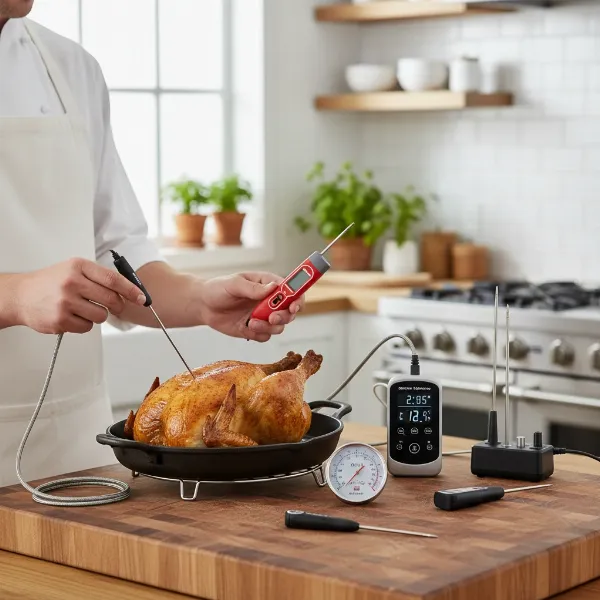 Various meat thermometers, handheld and leave-in, illustrating their use for precise cooking.
There are broadly two primary categories of meat thermometers that cater to different cooking needs: handheld (or instant-read) thermometers and leave-in (or probe/remote) thermometers. While both measure internal temperature, their design and functionality suit specific cooking scenarios.
Choosing the Right Meat Thermometer: Handheld vs. Leave-In
Selecting the ideal meat thermometer hinges on your cooking habits, the types of dishes you prepare, and your desired level of monitoring. Understanding the core differences between handheld and leave-in thermometers will guide you to make an informed choice that best fits your kitchen or grill.
Handheld (Instant-Read) Thermometers are designed for quick, on-the-spot temperature checks. You insert the probe into the thickest part of the meat, wait a few seconds for the reading to stabilize, and then remove it. They are ideal for foods that cook relatively quickly or for verifying doneness at various points in a larger cut before serving.
-
Pros of Handheld Thermometers:
- Speed: Delivers a temperature reading within 2-5 seconds, crucial for quick checks without significant heat loss.
- Accuracy: Often highly accurate, allowing you to pinpoint the exact temperature at different spots.
- Versatility: Excellent for grilling steaks, pan-searing poultry, checking burgers, or confirming doneness in multiple areas of a roast.
- Portability: Compact and easy to store, making them convenient for indoor and outdoor cooking.
-
Cons of Handheld Thermometers:
- No Continuous Monitoring: Requires you to open the oven or grill lid and manually insert the probe each time you want a reading, disrupting the cooking environment.
- Hands-On: You must be present to take readings, which isn’t ideal for long, slow cooks.
- Potential Heat Loss: Repeatedly opening an oven or grill can lead to temperature fluctuations and extend cooking times.
Leave-In (Probe/Remote) Thermometers are built for continuous temperature monitoring throughout the cooking process. A heat-resistant probe is inserted into the meat and remains there, connected by a wire to an external base unit or wirelessly to a receiver/smartphone app. This allows you to track the internal temperature without opening the oven or grill.
-
Pros of Leave-In Thermometers:
- Continuous Monitoring: Provides real-time updates on your meat’s internal temperature, perfect for slow cooking, smoking, or roasting.
- Remote Tracking: Many models feature a remote receiver or Bluetooth/Wi-Fi connectivity to a smartphone app, allowing you to monitor your cook from a distance.
- Alarms: Can be set to alert you when your desired temperature is reached, preventing overcooking.
- Hands-Off Convenience: Eliminates the need to constantly check the meat, freeing you to focus on other tasks or entertain guests.
-
Cons of Leave-In Thermometers:
- Potential for Inaccuracy: Some studies suggest that the metal probe and wire can conduct heat into the immediate area around the sensor, potentially leading to slightly higher (and false) readings, sometimes by as much as 5 degrees.
- Less Versatile for Spot Checks: Not designed for quickly checking multiple points in different cuts of meat.
- Wired Limitations: Wired models have cables that can be pinched, damaged, or limit placement. Fully wireless models often come at a higher price point.
- Limited Mobility: The base unit needs to be near the cooking apparatus, and wireless range can vary.
In-Depth Comparison Table: Handheld vs. Leave-In Meat Thermometers
To help you visualize the differences, here’s a comprehensive comparison:
| Feature | Handheld (Instant-Read) Thermometers | Leave-In (Probe/Remote) Thermometers |
|---|---|---|
| Monitoring | Spot checks, manual insertion | Continuous, real-time |
| Speed | Very fast (2-5 seconds) | Varies for initial reading, continuous updates |
| Accuracy | Generally very high for specific spot, but requires checking multiple areas | High, but can be influenced by heat conduction in probe/wire (Kenji Lopez-Alt suggests some can read 5 degrees high near the probe) |
| Portability | High, pocket-sized | Base unit often stationary, probe is inserted |
| Best For | Grilling, searing, pan-frying, quick checks, verifying final doneness | Roasting, smoking, slow cooking, baking large cuts |
| Setup | Minimal, just insert and read | Probe insertion, potential base unit placement/app setup |
| Cost | Generally lower to mid-range | Mid-range to high-end, especially for wireless/smart models |
| User Presence | Required for each reading | Allows remote monitoring, frees up the cook |
Detailed Review of Each Thermometer Type
Both handheld and leave-in thermometers offer unique advantages, making them valuable assets in any cooking arsenal.
Handheld (Instant-Read) Thermometers
These devices are the workhorses of quick temperature checks. Their design typically features a sharp, thin probe attached to a digital display.
- Design and Materials: Probes are usually made of food-grade stainless steel, often with a thin tip for minimal impact on the meat. The body might be plastic or metal, often with a comfortable grip. Many include a protective sheath for the probe.
- Accuracy and Speed: High-quality instant-reads boast accuracy within ±1°F (±0.5°C) and provide readings in just 2-5 seconds. This rapid response is crucial for grilling where every second counts.
- Special Features: Common features include large, backlit displays for easy reading in various lighting conditions, auto-off functions to conserve battery, hold buttons to lock in a reading, and some are waterproof for easy cleaning. Calibration features allow you to adjust for precision over time.
- Durability and Lifespan: With proper care, a good instant-read thermometer can last for years. Look for models with sturdy construction and high-quality components.
- Ease of Use and Cleaning: Their straightforward operation—insert and read—makes them user-friendly. Most are easy to clean with a damp cloth or by rinsing the probe under running water, especially if they are waterproof.
|
Our Picks for the Best Meat thermometer in 2026
As an Amazon Associate I earn from qualifying purchases.
|
||
| Num | Product | Action |
|---|---|---|
| 1 | Meat Thermometer Digital with 1 Second Instant Read, Large LED Display, Food Thermometer |

|
| 2 | TempPro TP829 1000ft Wireless Meat Thermometer Digital for Grilling and Smoking, 4 Meat Probes Grill Thermometer for Outside Grill, BBQ Thermometer for Cooking Food Temperature (Previously ThermoPro) |
|
| 3 | Alpha Grillers Meat Thermometer Digital - Instant Read Food Thermometer for Cooking and Grilling Gifts for Men Valentines Day Gifts for Him Her Mom Dad |
|
| 4 | ThermoPro TP03B Digital Meat Thermometer for Cooking, Instant Read Thermometer with Backlight, Kitchen Food Thermometer for Grill Smoker BBQ Oil Deep Fry Candy Bread Coffee with Pop-up Meat Probe |
|
| 5 | ThermoPro TP19H Digital Meat Thermometer for Cooking with Ambidextrous Backlit and Motion Sensing Kitchen Cooking Food Thermometer for BBQ Grill Smoker Oil Fry Candy Instant Read Thermometer |
|
| 6 | Ultrean Digital Meat Thermometer for Cooking,Ultra-Fast Instant Read Food Thermometer with Backlight,Foldable Probe,Waterproof Kitchen Thermometer for BBQ,Grill,Fry,Oven,Candy Making |
|
| 7 | Meat Thermometer Digital - Instant Read Food Thermometer for Cooking Grilling, Candy, Air Fryer, Griddle Probe Kitchen Gadgets Essentials BBQ Accessories, Valentines Day Gifts for Him Her, Red |
|
| 8 | Professional Meat Thermometer - Instant Read Food Thermometer with Waterproof Design, Backlight, Hold/Min/Max Function - Cooking Thermometer for Grilling, BBQ, Kitchen Use |
|
| 9 | Meat Thermometer Digital, Instant Read Meat ThermometerI for Grill and Cooking, Waterproof Food Thermometer for Kitchen and Outside, BBQ, Turkey, Candy, Liquids, Beef |
|
| 10 | 0.5 Sec Instant Read Meat Thermometer Digital with ±0.5℉ Precision, Food Thermometer for Cooking Kitchen Gadgets, Oven Grill Candy BBQ Essentials Accessories, Gifts for Him Dad Men Birthday, Red |
|
Leave-In (Probe/Remote) Thermometers
Designed for extended cooks, these thermometers offer continuous monitoring and often include advanced features for convenience.
- Design and Materials: Leave-in thermometers consist of one or more probes, usually with braided steel cables that can withstand high temperatures inside ovens or smokers. These cables connect to a base unit that displays the temperature, or in wireless models, transmits data to a remote receiver or a smartphone app.
- Accuracy and Speed: While they provide continuous readings, the initial response time when first inserted might be slightly longer than an instant-read. Their primary value lies in sustained monitoring. Some experts, like J. Kenji Lopez-Alt, a renowned culinary expert, have noted that heat conduction through the probe and wire can sometimes lead to slightly elevated readings compared to an instant-read, suggesting using the leave-in as a guide and an instant-read for final verification.
- Special Features: Modern leave-in thermometers often include Bluetooth or Wi-Fi connectivity for app-based monitoring, multiple probes to track different cuts or ambient grill temperature, programmable alarms for target temperatures, and pre-programmed USDA doneness settings.
- Durability and Lifespan: The probes and cables are generally built to be durable and heat-resistant. However, repeated bending or exposure to extreme heat can degrade the cables over time. Wireless models eliminate cable concerns but rely on battery life and signal strength.
- Ease of Use and Cleaning: Setup can involve pairing with a device or positioning the base unit. Cleaning typically involves wiping down the probes and cables, being careful not to submerge the base unit or wireless transmitter unless specifically designed to be waterproof.
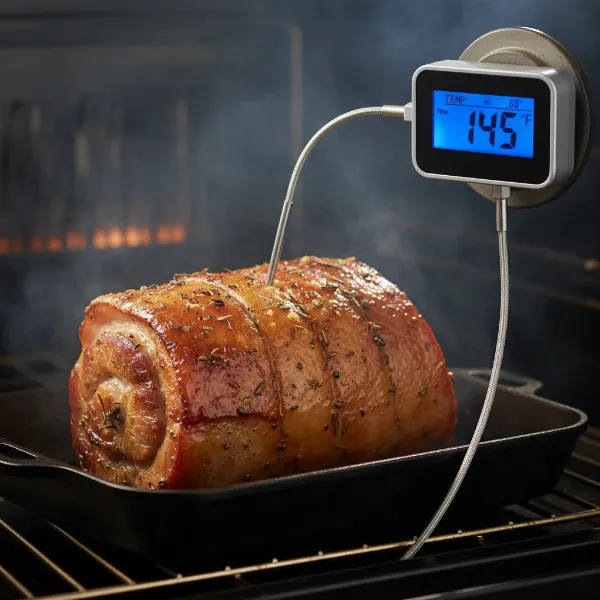 A leave-in meat thermometer probe inserted into a roasting pork loin, with the digital display unit showing temperature.
Using and Maintaining Your Meat Thermometer
Proper usage and maintenance are key to ensuring the accuracy and longevity of your meat thermometers.
How to Use Correctly:
- Instant-Read: Insert the probe into the thickest part of the meat, avoiding bone, gristle, or fat pockets, as these can give inaccurate readings. Wait for the temperature to stabilize, usually a few seconds. For larger cuts, check multiple spots to ensure even cooking.
- Leave-In: Insert the probe into the center of the thickest part of the meat before cooking begins. Ensure the cable is positioned so it doesn’t get pinched by the oven door or smoker lid. Set your desired temperature alarms on the base unit or app.
Calibration: Periodically check your thermometer’s accuracy. The ice bath method (a cup of crushed ice and water) should read 32°F (0°C), and boiling water should read 212°F (100°C) at sea level. If readings are off, some digital thermometers can be recalibrated following manufacturer instructions.
Cleaning and Storage:
- Always clean the probe thoroughly after each use with hot soapy water or an alcohol wipe to prevent cross-contamination.
- For wired probes, ensure cables are clean and free of kinks before storing.
- Store thermometers in a clean, dry place, protecting the probe tip. Many instant-reads come with a sheath.
Common Errors and Troubleshooting:
- Inaccurate Readings: Ensure the probe is inserted correctly and deeply enough. Calibrate your thermometer regularly. For leave-in probes, be aware of potential heat conduction affecting readings.
- Slow Readings: Check battery life. If using a leave-in thermometer, ensure it’s fully inserted and the connection to the base unit is secure.
- Display Issues: Replace batteries if the display is dim or erratic.
Elevating Your Cooking with Meat Thermometers
Using a meat thermometer transforms cooking from an art of guesswork to a science of precision, guaranteeing delicious and safe results every time.
Achieving Perfect Doneness: The most significant benefit is consistently hitting the ideal internal temperature for your desired doneness, whether it’s a rare steak, medium-well pork loin, or perfectly cooked chicken. This eliminates dry, overcooked meat and ensures juicy, flavorful results.
Target Temperatures for Different Meats:
- Beef, Pork, Veal, Lamb (steaks, roasts, chops): 145°F (63°C) for medium-rare, 160°F (71°C) for medium, 170°F (77°C) for well-done. (Allow for a 3-minute rest time after removing from heat).
- Ground Meats (beef, pork, veal, lamb): 160°F (71°C).
- Poultry (whole or ground): 165°F (74°C).
- Fish: 145°F (63°C).
Combining Both Thermometer Types: For the ultimate cooking experience, many experienced cooks recommend owning both a leave-in and an instant-read thermometer. Use the leave-in thermometer for continuous monitoring during long cooking processes like smoking a brisket or roasting a turkey. Then, as the meat approaches your target temperature, use a high-quality instant-read thermometer to quickly verify the temperature in several spots, including those away from the leave-in probe, for final accuracy. This dual-thermometer approach provides both convenience and precision, ensuring flawless results.
“For serious cooks, both a leave-in probe and an instant-read thermometer are indispensable tools. The leave-in gives you peace of mind during long cooks, while the instant-read provides the definitive, quick check for perfect doneness right before serving.” – Admin, meatthermometerreviews.com
Conclusion
The choice between leave-in and handheld meat thermometers ultimately comes down to your primary cooking needs and preferences. Handheld thermometers excel in speed and portability, making them ideal for quick checks and verifying doneness across various cuts. Leave-in thermometers, on the other hand, offer unparalleled convenience and peace of mind through continuous, remote monitoring for those extended cooking sessions.
For optimal versatility and accuracy, investing in both types is often the best strategy. Use a leave-in thermometer to track the overall cooking progress of larger roasts or smoked meats, and then confirm doneness with a precise instant-read thermometer in multiple locations just before resting. By understanding their unique strengths and weaknesses, you can harness the power of both to consistently achieve perfectly cooked, safe, and delicious meals. What will be your next culinary masterpiece, armed with the right meat thermometer?
Frequently Asked Questions
Can I use an instant-read thermometer as a leave-in thermometer?
No, instant-read thermometers are not designed to be left in meat during cooking. Their components are typically not heat-resistant enough for prolonged exposure to oven or grill temperatures, and leaving them in can damage the device and potentially lead to inaccurate readings.
How often should I check meat with a handheld thermometer?
For quicker-cooking items like steaks or chicken breasts, you can start checking a few degrees below your target temperature. For larger roasts, check when it’s approximately 10-15 degrees below the desired final temperature, and then more frequently as it gets closer. Avoid over-checking, as it can slow down cooking and dry out the meat.